Facebook
 X
X
 Pinterest
 Copy Link
Spring 2026 Nova Scotia Real Estate: Balanced Market, Normal Seasonality, and More Room to Negotiate
By Rob Lough, Broker/Owner | Century 21 Optimum Realty | April 2026
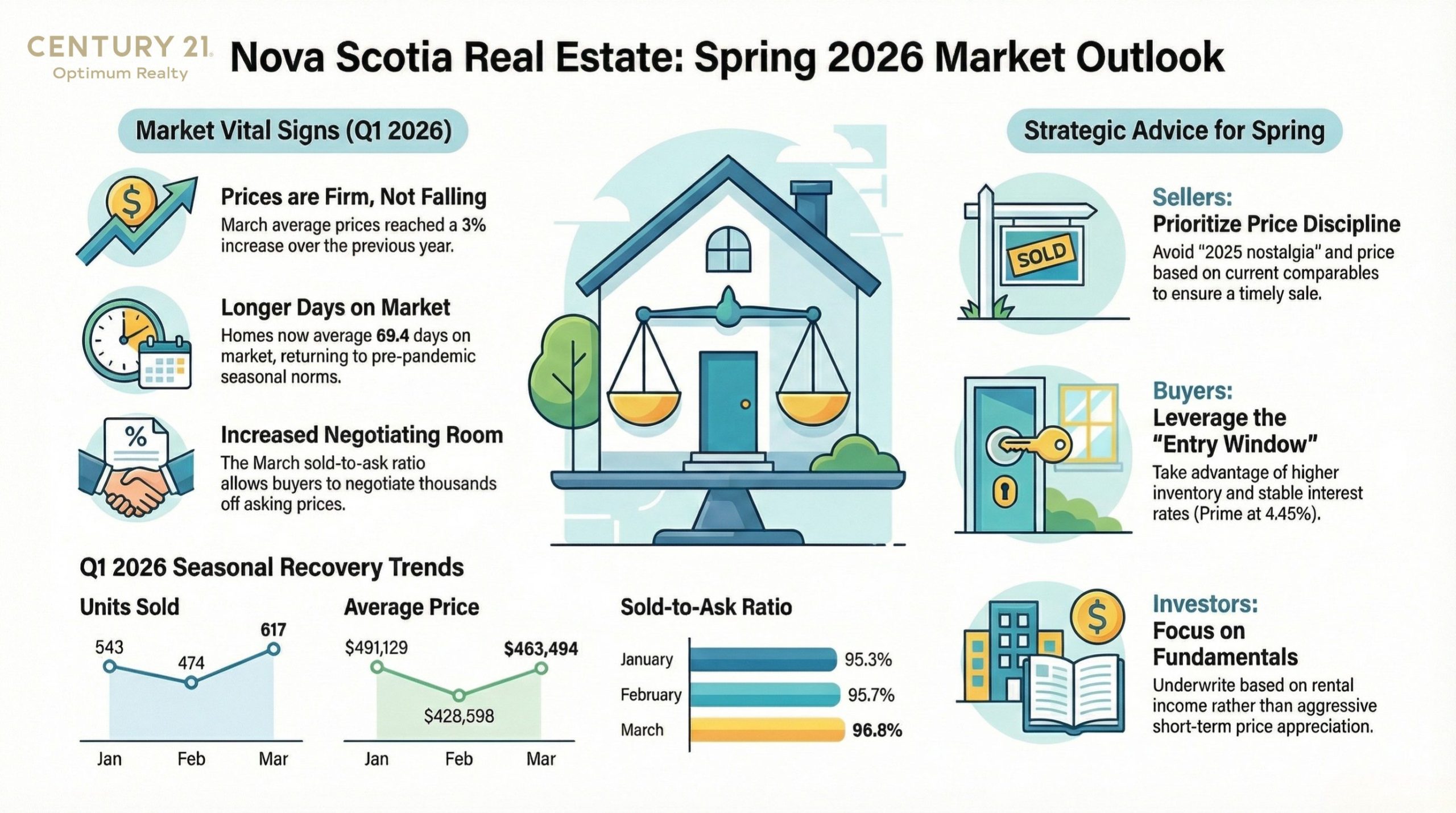
March’s numbers are in, and they confirm what the winter data was already pointing toward: Nova Scotia’s real estate market is entering spring 2026 in a more measured, negotiable environment than we saw a year ago. The frenzy of mid-2025 has given way to a more deliberate pace, with longer days on market, softer sold-to-ask ratios, and fewer transactions across the board.
But before anyone mistakes “slower” for “broken,” the headline worth holding onto is this: prices have held. That +1.0% year-over-year return we tracked through the winter tells an important story, this is not a market in freefall. It’s a market finding its footing after a busy year, and spring is already showing signs of the seasonal uptick we’d expect.
If you missed the winter months’ context, our Nova Scotia Real Estate Market Stats for February 2026 walks through the data in detail, and our Nova Scotia Real Estate Market Stats March 2026 report covers the earliest signs of spring stabilization. For the full year-end story of how we got here, our Nova Scotia Real Estate Market Statistics 2025 article provides the complete picture.
Prices: Firm, Not Falling
Average Price of Homes Sold Spring 2026 Nova Scotia Real Estate
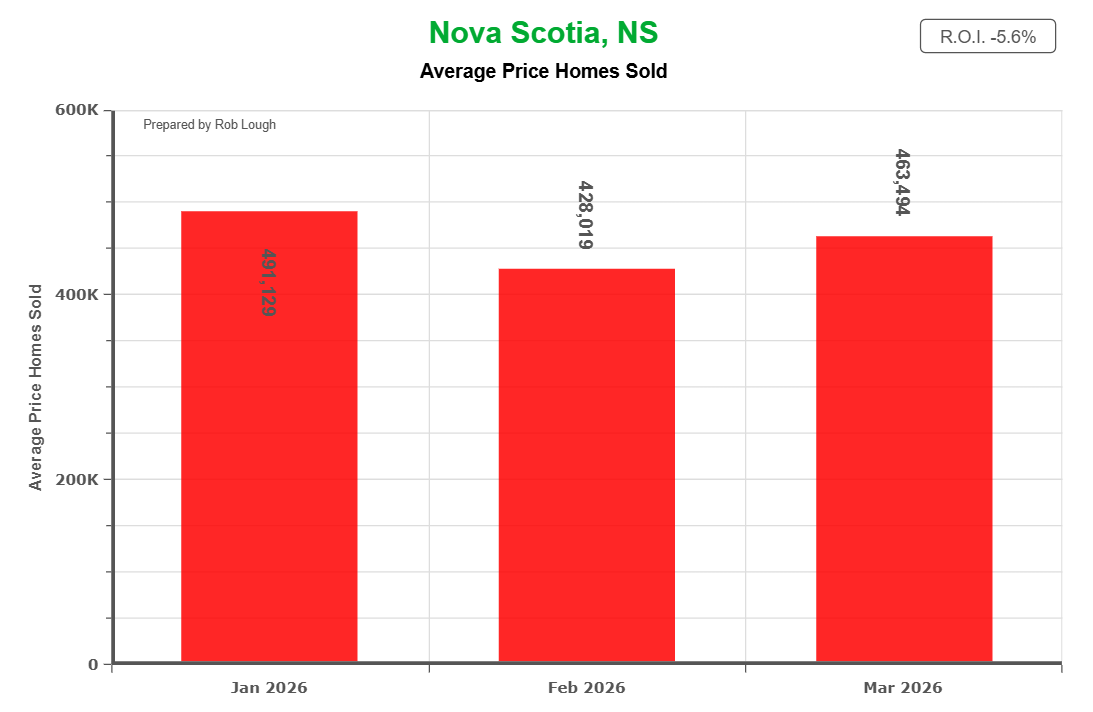
Average prices through the first quarter of 2026 have traced a classic seasonal arc: a record January high of $491,129 (up 11.3% year over year, the highest January average on record for the province), a predictable dip to $428,598 in February (essentially flat versus February 2025), and a March recovery to approximately $463,494, roughly 3% above March 2025.
That pattern, spike in January driven by higher-end closings, dip in February as the sales mix shifts, and a spring recovery as more properties transact, is textbook Nova Scotia seasonality. It does not signal a price correction. What it signals is a market behaving the way our market is supposed to behave.
For more detail on how January set up this year’s trends, see our Nova Scotia Real Estate Market Stats January 2026 report. And for a longer-range view of where this market has been, our Five Years of Nova Scotia Real Estate Market Analysis (2021–2025) puts today’s numbers in proper historical context.
Activity and Negotiation: Buyers Have Gained Leverage
Number of homes Sold Spring 2026 Nova Scotia Real Estate
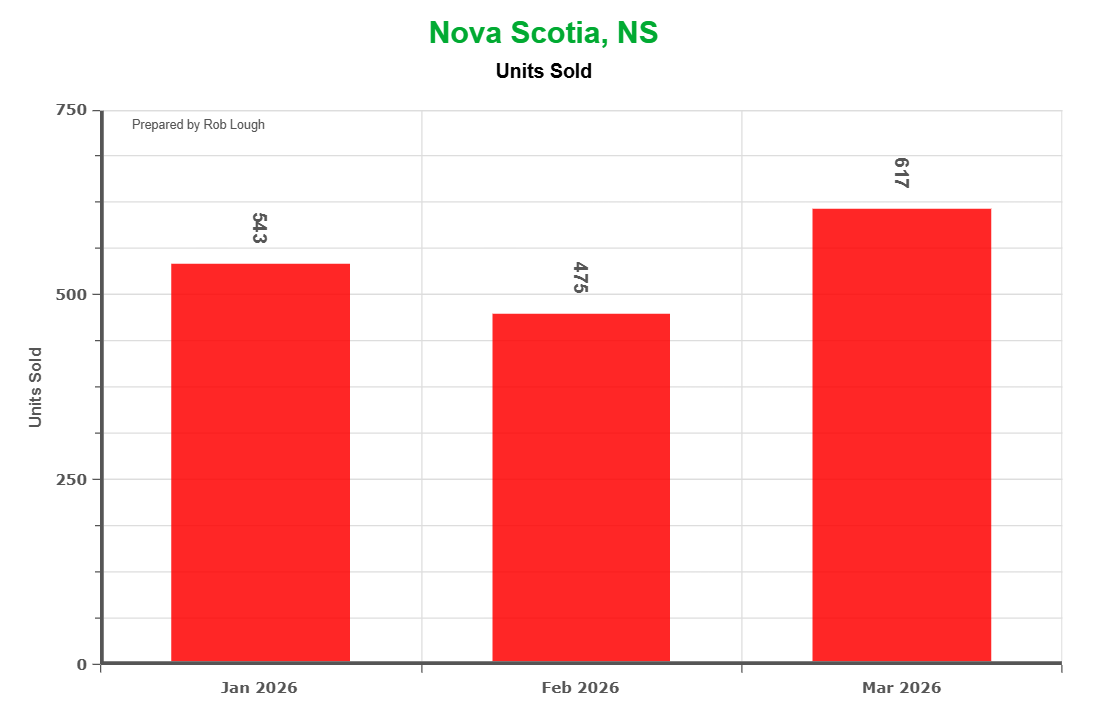
Fewer homes are selling, they’re taking longer to move, and buyers are negotiating harder. Those three facts are worth understanding together rather than in isolation.
Units sold came in at 543 in January 2026, 474 in February, and 617 in March, all below the comparable 2025 months. The spring ramp is underway, but we’re not at last year’s summer pace of 1,000+ transactions per month yet.
Days on market climbed from a summer 2025 low of 39.2 days all the way to 69.4 days in March 2026. Homes are sitting for more than two months on average before finding a buyer. That’s not alarming, our Ten Years of Nova Scotia Real Estate in Five Key Charts shows that pre-pandemic norms ran in the 60–90 day range, but it is a meaningful shift from what sellers experienced last year.
The sold-to-ask ratio tells a similar story. At 95.3% in January and 95.7% in February before recovering to 96.8% in March, buyers are typically negotiating roughly $14,000–$18,000 off the asking price on a $400–500K home. During the June–July 2025 peak, that ratio held at 98.4%, leaving buyers almost no room to move. That has changed.
For a closer look at our largest urban market through this period, the Halifax-Dartmouth Real Estate Market Stats January 2026 report shows how HRM’s numbers, including a 97% sold-to-ask ratio and 52.6 days on market, tracked slightly stronger than the provincial average, as the city typically does.
What to Expect This Spring
Value of homes Sold Spring 2026 Nova Scotia Real Estate
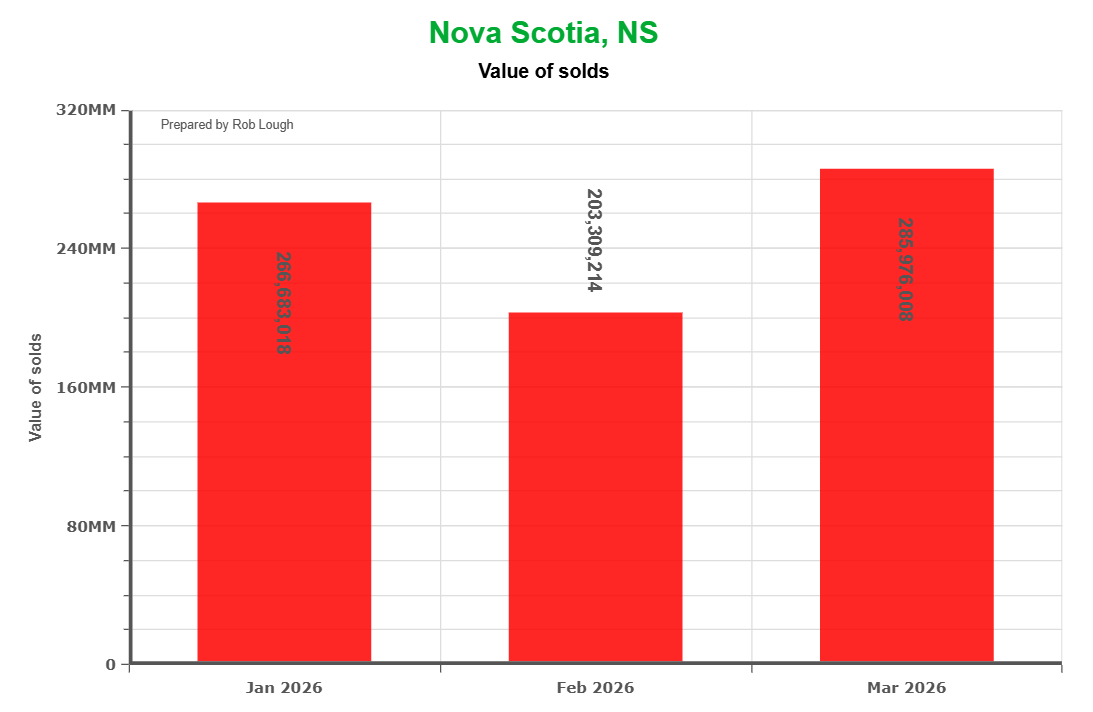
If past years are any guide, activity should pick up through April and May as the spring market takes shape. Listings increase, buyer foot traffic rises, and the sold-to-ask ratio firms as more competition returns to well-priced properties.
The seasonal arc in Nova Scotia is deeply embedded. We’ve seen it play out across multiple rate environments, supply conditions, and economic backdrops. Spring doesn’t erase the winter dynamics, but it does shift the balance. Sellers who sat through a quiet February and March will find more qualified buyers in front of their listings over the next sixty days. Buyers who have been shopping patiently will see more inventory arrive and in some pockets, more competition returning for the best properties.
The Bank of Canada holding its overnight rate at 2.25%, with prime sitting around 4.45%, means the borrowing environment is stable and predictable. That’s a meaningful support for buyer confidence heading into the busiest months of the year.
What This Means for Sellers
Price discipline is the single most important factor right now. With days on market approaching 70 days provincially and buyers negotiating 3–4% below asking on average, overpriced listings are not finding buyers, they’re training buyers to wait you out.
The good news: values have held. If you’re pricing from current, accurate comparables rather than summer 2025 nostalgia, you’re entering the spring market with a realistic chance of a timely sale. Our buying and selling tips page has practical guidance on positioning your property, and if you want to know what your home is actually worth in today’s conditions, our What’s My Home Worth? tool is the right starting point.
Sellers should also note that the first-time buyer pool is better supported right now than it’s been in years, with programs like Nova Scotia’s 2% Down Payment Program helping more entry-level buyers qualify. Properties priced at or below the first-time buyer threshold are well-positioned to attract motivated, program-eligible purchasers this spring.
What This Means for Buyers
This is one of the more favourable buying environments Nova Scotia has seen since before the pandemic surge. Days on market are long, negotiation room is real, and spring inventory is arriving. The urgency that pushed buyers into quick decisions with no conditions in 2022 and 2023 is not in this market right now.
That said, well-priced properties in desirable areas are still moving. Patience is an asset; complacency isn’t. When the right property comes along, being pre-approved and ready to act is what separates buyers who get the house from buyers who send another lowball offer on a listing that just sold.
Get pre-approved for a mortgage before you fall in love with a property. Use our mortgage calculator to model your monthly payments at today’s rates. And if you want to understand how programs can stack to make a new build significantly more affordable, our article on how Nova Scotia first-time buyers can stack federal and provincial programs is required reading.
What This Means for Investors
Flat year-over-year prices, softening sold-to-ask ratios, and longer days on market point to a potential entry window where fundamentals matter more than short-term appreciation. Underwriting should assume modest price growth and lean on rent income as the primary return driver. The 2026–27 Nova Scotia Budget introduced programs supporting rental housing supply, which shapes the competitive environment for income-property investors. Factor in the new investment property mortgage qualification rules that came into effect in January 2026 when running your numbers.
Bottom Line
Spring 2026 is arriving in a market that is normalizing, not collapsing. Prices are firm. Seasonal activity is returning. And buyers have more time, more inventory, and more negotiating power than they did at this point last year. A new province-wide NSAR survey puts hard numbers behind that sentiment — 73% of non-owners still want to buy, but 77% say housing is unaffordable.
For buyers, that’s opportunity. For sellers, it’s a call to meet the market rather than fight it. For investors, it’s a window to acquire with less competition and more realistic seller expectations.
Nova Scotia real estate remains fundamentally sound. Population growth, long-term economic investment in the region, and constrained new construction relative to demand all support the market over time. The question for spring 2026 is simply whether buyer confidence, and the listings to match it, can build into the kind of active market we saw a year ago.
We’ll be watching the April and May data closely.
Related Resources
- Nova Scotia Real Estate Market Stats March 2026
- Nova Scotia Real Estate Market Stats for February 2026
- Nova Scotia Real Estate Market Stats January 2026
- Nova Scotia Real Estate Market Statistics 2025
- Five Years of Nova Scotia Real Estate Market Analysis (2021–2025)
- Ten Years of Nova Scotia Real Estate in Five Key Charts
- Halifax-Dartmouth Real Estate Market Stats January 2026
- Nova Scotia’s 2% Down Payment Program
- How First-Time Buyers Can Stack Federal and Provincial Programs
- 2026–27 Nova Scotia Budget: What Buyers, Renters & Investors Need to Know
- Get Pre-Approved for a Mortgage
- Mortgage Calculator
- What’s My Home Worth?
- Buying and Selling Tips