Facebook
 X
X
 Pinterest
 Copy Link
The Homeownership Dream Is Still Alive in Nova Scotia. The Math Is What’s Broken.
By Rob Lough, Broker/Owner | Century 21 Optimum Realty | Halifax-Dartmouth, Nova Scotia Published: April 2026
Here’s something that doesn’t get said enough in conversations about Nova Scotia’s housing crisis: most people still want to own a home. They haven’t given up. They haven’t decided renting is fine. They haven’t moved on.
What they’ve done is run the numbers and the numbers don’t work.
New research from the Nova Scotia Association of REALTORS, conducted by Abacus Data and released this spring, lays out exactly where Nova Scotians stand on housing in 2026. The results paint a picture that is less about despair and more about a province full of people who want something they’re being priced out of reaching.
That distinction matters, because it changes what the solution actually looks like.
Most Nova Scotians Still Want to Own
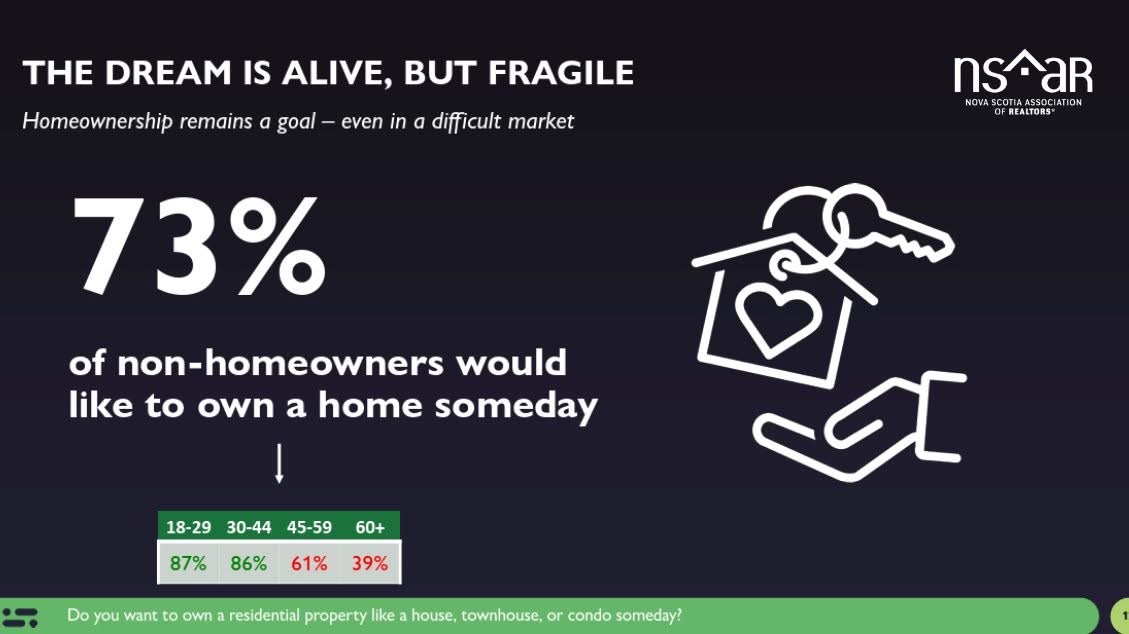
Among Nova Scotians who don’t currently own a home, 73% say they want to someday.
Among Nova Scotians who don’t currently own a home, 73% say they want to someday. Among adults under 30, that number is 87%. Among those aged 30 to 44, it’s 86%.
These are not small numbers. They represent the overwhelming majority of renters and non-owners in this province, people actively hoping to cross the threshold into ownership, not people who’ve made peace with staying on the sidelines.
That motivation is real, and it shows up in our offices every week. Buyers who have been watching the market for one, two, sometimes three years. People who are pre-approved but can’t find something at a price that works. First-time buyers who have the income to carry a mortgage but can’t bridge the upfront cash gap.
The aspiration is there. The pathway keeps getting narrower.
The Gap Between Wanting and Getting
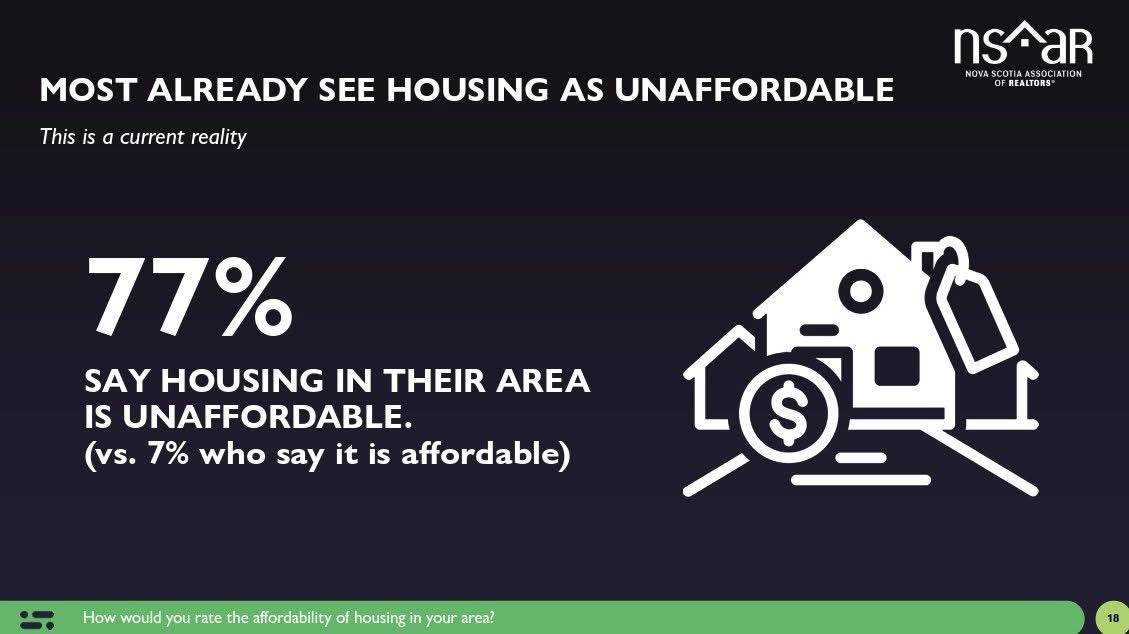
survey asked Nova Scotians to rate housing affordability today, 77% said housing in their area is unaffordable.
When the same survey asked Nova Scotians to rate housing affordability today, 77% said housing in their area is unaffordable. Only 7% said it is affordable.
That 70-point spread between the people who want to own and the people who think the market is accessible tells you everything about where the pressure is. It’s not a confidence problem or a desire problem. It’s a price problem and behind the price problem is a supply problem and a construction cost problem that the province has been grappling with for years.
Our Nova Scotia Real Estate Market Stats for March 2026 put the provincial average sale price at approximately $463,000, more than 50% higher than it was in early 2021. For a buyer putting down 5% on a $463,000 home, that’s $23,150 in down payment alone, before legal fees, land transfer tax, home inspection, title insurance, and prepaid property taxes are factored in. For many Nova Scotians earning average wages, accumulating that upfront cash while paying today’s rents is the single biggest obstacle between where they are and where they want to be.
What Nova Scotians Actually Want Done
The NSAR/Abacus research didn’t just measure the problem, it asked people what they think would actually fix it. The answers are instructive, and perhaps surprising.
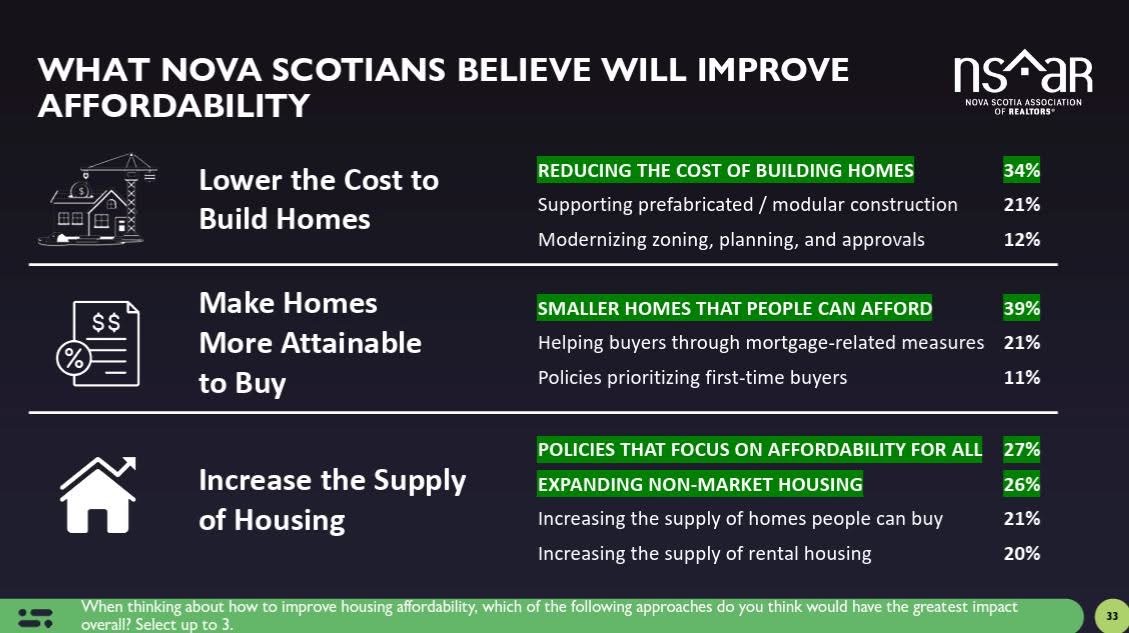
The single most popular response, at 39%, was straightforward: build smaller homes that people can afford. Not a new government program. Not a tax credit. Not a mortgage subsidy. Smaller homes at reachable prices.
That response topped every other option in the survey, across all three solution categories tested. Reducing the cost of construction came in at 34%. Policies focused on affordability for all drew 27%, and expanding non-market housing drew 26%. Mortgage-related measures and first-time buyer policies each drew around 21% and 11% respectively.
Read together, Nova Scotians are telling their government and their industry something clear: the product itself needs to change. The market has been building homes that an increasingly small share of the population can afford to buy. The solution isn’t just more of the same, it’s different product at different price points.
This is consistent with what our 2026–27 Nova Scotia Budget breakdown identified as one of the budget’s key gaps: government investment in supportive housing and homelessness is meaningful, but the missing middle, attainable ownership housing for working Nova Scotians, remains undersupplied.
The Concern Is Universal, But Not Evenly Felt
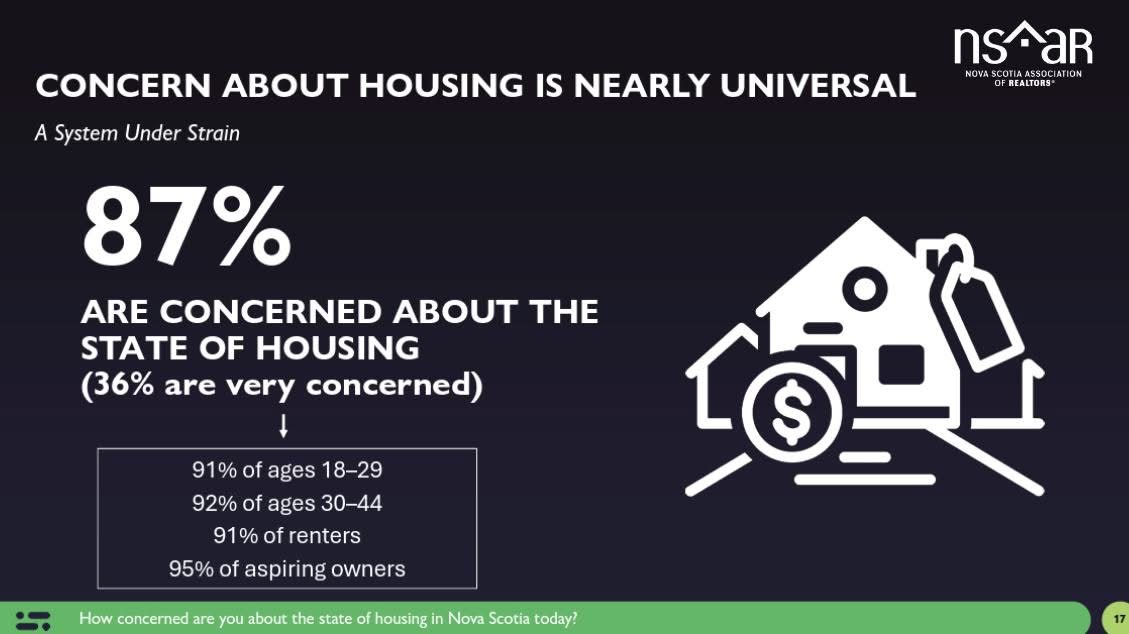
Eighty-seven percent of Nova Scotians say they are concerned about the state of housing in the province.
Thirty-six percent say they are very concerned. Those numbers are high enough that they’re essentially describing a consensus, not a political position or a demographic segment, but the broad view of the province.
But concern is not evenly distributed. Among renters, 91% are concerned. Among aspiring homeowners, 95% are concerned. Among adults aged 30 to 44, the cohort most actively trying to buy, 92% are concerned.
These are the people sitting across from us at kitchen tables, trying to figure out whether this spring is the right time to make a move. They are not pessimistic about homeownership in the abstract. They are frustrated by the specific gap between what they can afford and what the market is offering them.
Where the Real Opportunities Are Right Now
The NSAR data is a provincial snapshot, but the opportunities are local and they’re real.
The programs available to first-time buyers in 2026 are genuinely the strongest we’ve seen in years. Nova Scotia’s 2% Down Payment Assistance Program directly addresses the upfront cash barrier that the survey identifies as the core problem, allowing eligible buyers to purchase with just 2% down on homes up to $570,000 in HRM and East Hants. Our detailed guide on stacking federal and provincial programs shows how the Bill C-4 GST rebate, the down payment program, and extended amortizations can work together for buyers of new construction.
For buyers with flexibility on location, the value gap between HRM and central Nova Scotia remains significant. Our Five Years of Nova Scotia Real Estate Market Analysis puts the full price appreciation story in context and makes clear that markets outside HRM have absorbed far less of that 50% run-up than Halifax and Dartmouth have.
For sellers, the survey results are a useful reminder of who your buyer is. Seventy-three percent of non-owners in this province want to own someday. The buyers are there. What they need is product priced within reach of what the market currently qualifies them for, which, in a spring 2026 environment with softened sold-to-ask ratios and longer days on market, means accurate pricing matters more than it has in years. Our Spring 2026 Nova Scotia real estate overview covers exactly where the market sits heading into the busiest months of the year.
The NSAR research doesn’t reveal a province that has given up on homeownership. It reveals a province that wants it badly, sees the path as increasingly difficult, and has a fairly clear idea of what needs to change. For buyers who are still in the game, pre-approved, patient, and prepared, this market has more room to negotiate than it has since before the pandemic surge. The tools are there. The motivation is there. The question is whether the product and the policy will catch up to the demand.
Related Resources
- Nova Scotia Real Estate Market Stats — March 2026
- Nova Scotia’s 2% Down Payment Program
- How First-Time Buyers Can Stack Federal and Provincial Programs
- Spring 2026 Nova Scotia Real Estate Overview
- Five Years of Nova Scotia Real Estate — 2021 to 2025
- 2026–27 Nova Scotia Budget: What Buyers and Investors Need to Know