Facebook
 X
X
 Pinterest
 Copy Link
2026–27 Nova Scotia Budget: What Every Halifax Homebuyer, Renter, and Investor Needs to Know
By Rob Lough| Broker/Owner, Century 21 Optimum Realty | February 2026
The Nova Scotia government’s 2026–27 provincial budget dropped a significant investment in housing and whether you’re a first-time buyer, a rental property investor, or a homeowner thinking about adding a secondary suite, there’s something in this budget that directly affects your next move. Here’s a plain-language breakdown of what matters most for buyers and sellers across the Halifax Regional Municipality, East Hants, and beyond.
A Budget Built Around Housing Supply
After years of record demand and tight inventory across Nova Scotia, the province is responding with a supply-side strategy, meaning the focus is on building more units, supporting more renters, and reducing barriers for developers. The overall investment in housing and affordability measures is substantial, and the ripple effects will be felt across the Halifax real estate market for years to come.
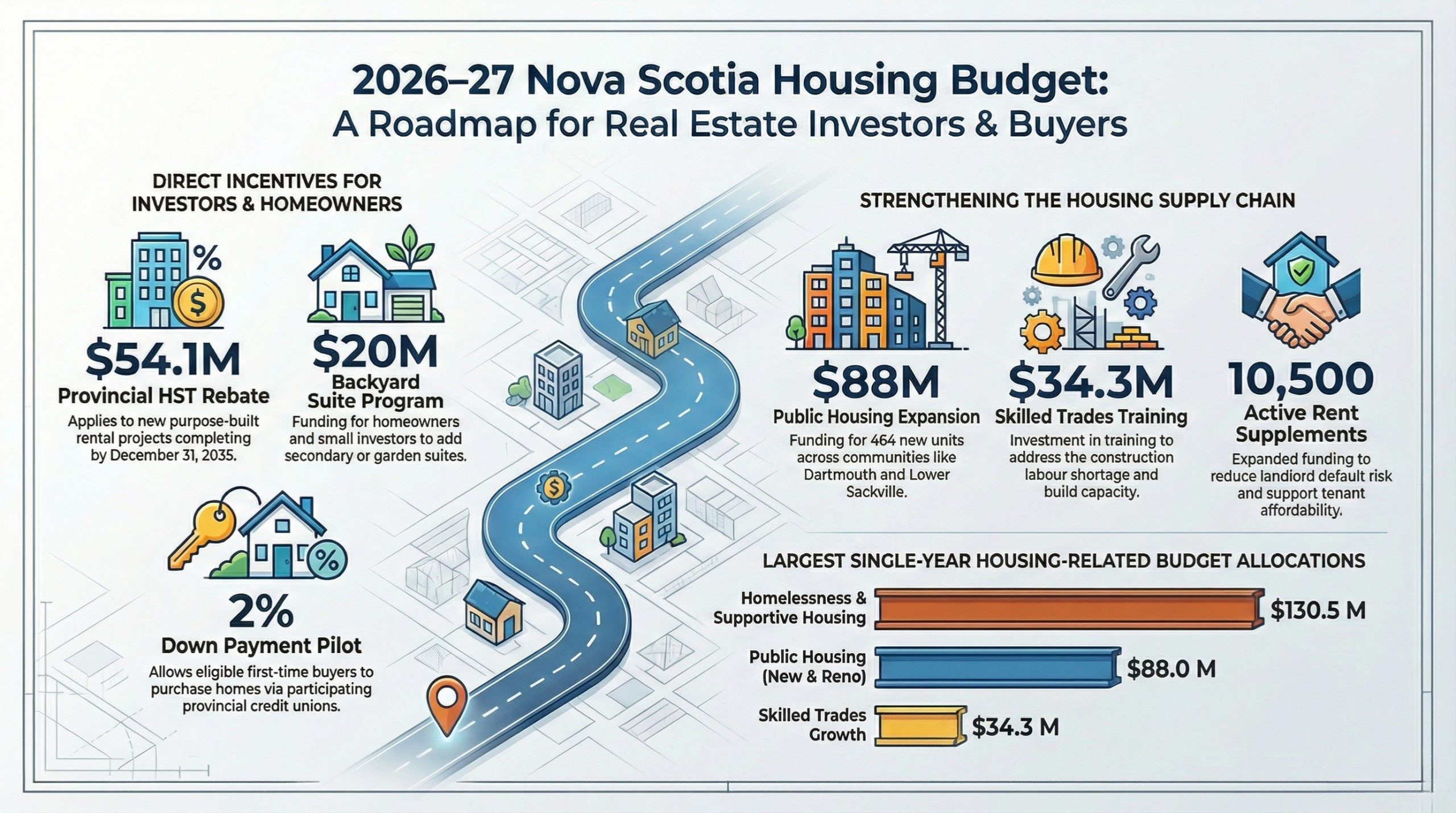
$88 Million for Public Housing: What It Means for the Market
The budget commits $88 million toward building, renovating, and maintaining public housing, including the first new public housing builds in over two decades. That includes:
$36.8 million (third year of funding) for 222 new public housing units, plus $10.6 million for an additional 242 units currently in the pipeline. Communities including Lower Sackville, Glace Bay, Kentville, Windsor, and Shannon Park in Dartmouth are among the targeted locations.
For private market participants, this matters because non-market supply absorbs demand from the lowest end of the rental spectrum, which can gradually ease pressure throughout the broader rental market. It won’t happen overnight, but it’s the most direct housing investment Nova Scotia has made in a generation.
The HST Rebate on Purpose-Built Rentals: A Game-Changer for Investors
This is arguably the single most impactful measure in the budget for real estate investors. The provincial HST rebate continues for new purpose-built rental projects that started construction on or after September 14, 2023 and complete by December 31, 2035. The estimated fiscal impact is $54.1 million in 2026–27 alone.
Combined with the federal GST/HST rental rebate announced in 2023, this significantly improves the financial viability of new multi-unit rental development. If you’re an investor or developer evaluating a purpose-built rental project in HRM or elsewhere in Nova Scotia, this is the pro forma improvement that could make a project pencil out. Reach out to our team to discuss how this might apply to properties or land you’re considering.
Backyard and Secondary Suites: $20 Million Over Three Years
The Backyard Suites Incentive Program receives another $6.9 million in this budget, bringing its three-year total to $20 million. This program supports homeowners and small-scale investors who want to add a secondary or garden suite to an existing property.
For homeowners, this can generate rental income that offsets mortgage costs. For investors, it’s an opportunity to increase cash flow on existing single-family holdings, where zoning and municipal permitting allow. If you’re thinking about whether a property you own or are considering buying could support a secondary unit, our team can help you evaluate the opportunity.
Rent Supplements Expanding to 10,500 Active Recipients
The budget ramps up rent supplement funding significantly, moving toward 10,500 active rent supplements, up from the roughly 8,900 currently in place. An additional $10.9 million is earmarked for 1,000 supplements specifically targeting individuals facing gender-based violence.
For landlords, rent supplements mean a portion of your tenant’s rent is backed by government funding, reducing default risk. As this program expands, more tenants across Nova Scotia will be supplement-eligible, which has implications for landlord risk assessment and vacancy rates in affordable rental segments.
First-Time Homebuyers Pilot: 2% Down Through Credit Unions
One of the more eye-catching announcements is the First Time Homebuyers Pilot Program, which allows eligible buyers to purchase a home with as little as a 2% down payment through participating provincial credit unions. Details are still emerging, but for buyers who’ve been sidelined by down payment requirements, this could open a door. New NSAR research shows Nova Scotians are clear on what they want, 39% say smaller, more attainable homes are the top priority, ahead of any government program.
It’s worth noting that a smaller down payment means a larger mortgage, so the qualification math and stress test still matter. If you’re a first-time buyer trying to figure out whether this program works for you, start with a conversation with our team. We’ve been helping Nova Scotians navigate first-time purchases for over 24 years and can help you connect with the right lenders and understand your full range of options.
Student Housing Investment: Easing Campus Rental Pressure
The budget allocates $30.8 million for new student housing at NSCC Cumberland and NSCC Kingstec campuses. For investors who own rental properties near those campuses, this will eventually bring new purpose-built beds online, which could affect vacancy rates in those micro-markets. Monitoring how quickly construction progresses and when units come online will be important for anyone with rental holdings in those areas.
$130 Million for Homelessness and Supportive Housing
The budget’s largest single housing-related investment is $130.5 million for homelessness and housing stability, including $77.9 million for supportive housing, $33.6 million for shelter capacity, and $25.2 million to create 378 new supportive housing units. The Tiny Homes Community in Lower Sackville receives $1.8 million to support up to 70 residents.
This level of investment in the supportive housing continuum gradually moves vulnerable individuals out of informal or private-market housing arrangements and into purpose-built supportive units, which has downstream implications for low-end rental demand.
$34 Million for Skilled Trades: Addressing the Labour Bottleneck
No housing supply discussion is complete without addressing the labour gap. The budget commits $34.3 million to accelerate skilled trades growth, including $5 million for the new Institute of Skilled Trades. This is a long-game investment — training today’s apprentices means more capacity to build tomorrow’s homes. For developers and builders, this signals the province is aware that labour is as much a constraint as land and financing.
The Bottom Line for Nova Scotia Buyers, Sellers, and Investors
This budget sends a clear message: Nova Scotia is committed to growing housing supply across all segments, market, non-market, supportive, and student. For buyers, sellers, and investors active in the Halifax real estate market right now, the key programs to watch are:
The purpose-built rental HST rebate for investors and developers building new multi-unit rental projects. The Backyard Suites Incentive for homeowners and small investors adding secondary units. The First Time Homebuyers Pilot for clients who’ve been saving for a down payment. The rent supplement expansion for landlords with tenants in the affordable segment.
Government investment alone won’t solve Nova Scotia’s housing affordability challenge, but the combination of direct public building, HST relief, and buyer programs represents the most comprehensive package the province has assembled in years.
Thinking About Your Next Move?
Whether you’re a first-time buyer exploring new programs, an investor evaluating a rental development opportunity, or a homeowner wondering whether a backyard suite makes sense for your property, our team at Century 21 Optimum Realty is here to help. With 24 years of experience in Nova Scotia real estate, we know this market — and we know how to help you make the most of it.
📞 Contact us today to talk through what this budget means for your real estate goals.