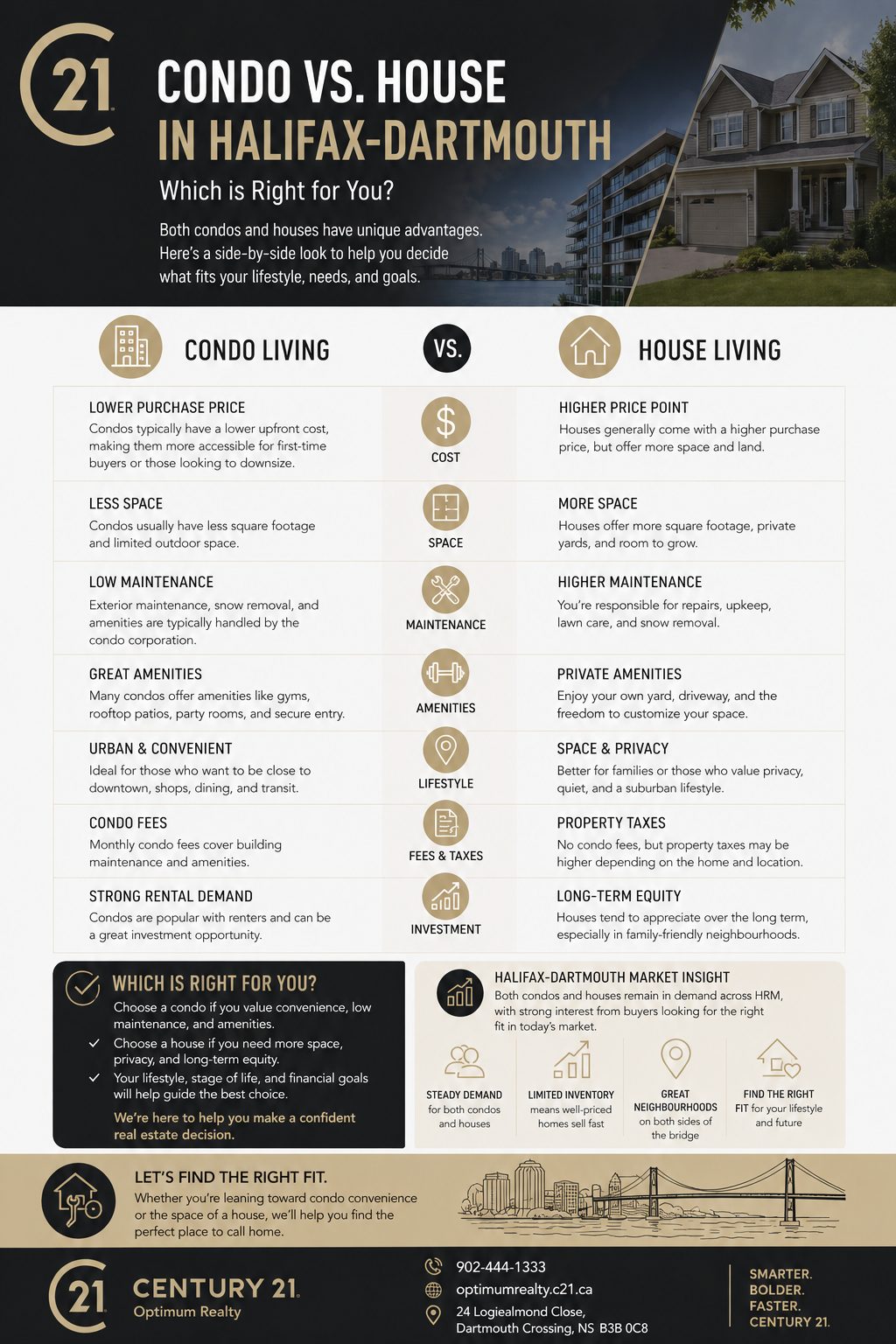
If you've been watching the Halifax-Dartmouth real estate market over the past decade, you know it has been anything but predictable. But the full story only comes into focus when you place two property types side by side, the single-family home and the condo apartment, and trace their paths across ten years of verified NSAR data.
This article does exactly that. Using sales data from the Nova Scotia Association of REALTORS® (NSAR) via InfoSparks, I've pulled annual averages for sale prices, total units sold, and price per square foot for both property types from 2016 through early 2026. The resulting picture is one of a market where condos and single-family homes started the decade close in price, diverged dramatically through the pandemic boom, and are now settling into a new equilibrium that every buyer and seller in HRM needs to understand. For where the market stands right now, the Halifax-Dartmouth Real Estate Market Stats: April 2026 and the Halifax-Dartmouth Condo Market Report: April 2026 provide the most current read on both segments.
For the provincial backdrop to this Halifax-specific story, the Ten Years of Nova Scotia Real Estate in Five Key Charts article on optimumrealty.c21.ca provides essential context. And for the five-year arc of price appreciation that reshaped affordability across the region, see the Five Years of Nova Scotia Real Estate Market Analysis (2021–2025). This article drills into what those broader trends looked like specifically for Halifax-Dartmouth and specifically for the condo vs. house comparison.
Average Sale Price: Condo vs. Single-Family Home (Annual Average, 2016–2025)
The chart below plots annual average sale prices for both property types across ten full years. Annual averaging smooths out month-to-month volatility and gives a cleaner read on where the two segments have actually been and how far they've diverged.
In 2016, the average single-family home in Halifax-Dartmouth sold for approximately $303,000. The average condo that year came in around $263,000 — a gap of roughly $40,000, or about 13%. Condos were the more accessible entry point, as expected.
Both property types drifted modestly upward through 2017, 2018, and 2019 — annual appreciation in the 2–4% range, consistent with Halifax's historically stable pre-pandemic pace. Then 2020 changed everything.
Single-family homes accelerated sharply. By 2021, the average house had crossed $488,000. By 2022, the annual average peaked near $555,000. Condos rose too, but more modestly in absolute terms — reaching the low $450,000s at their 2022 annual average. The gap between the two property types, once measured in tens of thousands, had grown to over $100,000.
The 2023 and 2024 data show continued strength for single-family, with condos plateauing in the $480,000–$490,000 range before some softening. In early 2026, single-family transactions in Halifax-Dartmouth are routinely closing in the $620,000–$660,000 range. Condos are running $465,000–$535,000 depending on the month, with spring 2026 showing renewed strength — as detailed in the Halifax Condo Market Report for March 2026.
2016 to 2025
2016 to 2025
appreciation, decade
The price gap between a Halifax-Dartmouth condo and a single-family home has grown from roughly $40,000 in 2016 to over $130,000–$150,000 today. For buyers working with a fixed pre-approval, that gap is the difference between being in the market and being on the sidelines. Condos are not a consolation prize — they're a legitimate entry point into Halifax homeownership, and the data shows they've delivered real appreciation over the decade.
Single-family sellers in 2026 are operating at price levels that would have been unimaginable in 2016. With averages near $630,000–$660,000, the market is far off its 2021–2022 rate-fueled urgency, but prices have held at levels that still represent extraordinary equity growth for anyone who purchased before 2020. Precise pricing matters now more than ever. For current context, see the Halifax-Dartmouth market stats for March 2026.
Total Units Sold Per Year: Condo vs. Single-Family Home (2016–2025)
Price tells one story. Volume tells another. The chart below tracks how many single-family homes and condo apartments actually changed hands each year — a measure of market depth, buyer demand, and available inventory across Halifax-Dartmouth.
Single-family sales volume peaked dramatically in 2020 and remained elevated through 2021. In those two years, Halifax-Dartmouth recorded its highest single-family transaction counts in this dataset — a reflection of pent-up pandemic demand, historically low interest rates, and an unprecedented wave of out-of-province buyers choosing Nova Scotia.
Condo volume tells a different story. Annual condo sales climbed from roughly 560 in 2016 to their own peak near 1,075 units in 2021 — nearly doubling over five years. While still a fraction of single-family transaction totals, the condo segment grew meaningfully as a share of overall market activity, driven by affordability pressures and an increasingly urban Halifax core attracting younger buyers and downsizers alike.
By 2022 and 2023, rising interest rates cut single-family volumes significantly relative to peak. The Nova Scotia Real Estate Market Statistics 2025 year-end report captures how the province navigated that volume contraction while prices held far more firmly than transaction counts did. Condo volumes contracted too, but held up proportionally — a sign the segment continues to attract buyers motivated by lifestyle and accessibility rather than pure market timing.
For early 2026, monthly data through March shows spring momentum building for both property types, consistent with the seasonal patterns documented in the Nova Scotia March 2026 market stats and the Halifax condo report for February 2026.
Lower transaction volumes mean less competition compared to the 2020–2021 frenzy. If you've been waiting on the sidelines expecting a return to bidding-war conditions, the volume data says the market has normalized — not crashed. Spring typically brings a meaningful lift in Halifax activity, and 2026 is showing that seasonal ramp beginning now. Getting pre-approved and prepared before the peak spring competition window is the highest-leverage move a buyer can make.
The volume data confirms the pool of active buyers is smaller than it was in 2020–2021 — but buyers are still transacting. Spring and summer remain the clear seasonal peaks. Sellers who time their listing for March through June, price with precision, and invest in professional presentation continue to close successfully. The buyers are out there. Reaching them requires strategy, not just signage.
Average Price Per Square Foot: Condo vs. Single-Family Home (Annual Average, 2016–2025)
Price per square foot strips out the size variable and gives the cleanest apples-to-apples comparison between property types. A condo is typically much smaller than a house — so comparing total sale prices alone doesn't tell you which type actually costs more per unit of space. The results here are illuminating, and frankly counterintuitive to many buyers.
In 2016, single-family homes averaged around $198 per square foot across Halifax-Dartmouth. Condos averaged approximately $236 per square foot — a premium of nearly $38 per foot for the smaller, more urban product. You paid more per square foot for a condo than for a house, not less.
That per-square-foot premium held throughout 2017, 2018, and 2019. During the pandemic boom, single-family prices surged on a per-square-foot basis — reaching annual averages near $386/sqft for houses by 2022. Condos kept pace throughout, averaging closer to $427/sqft in 2022 on an annual basis. The condo premium, measured in dollars per square foot, was remarkably persistent across the entire cycle.
Through 2023 and 2024, single-family per-square-foot values settled in the $398–$415 range. Condos have shown more month-to-month volatility — a function of smaller sample sizes and variability of individual unit sizes and locations — but averaged in the $463–$477 range. The per-square-foot condo premium, present since at least 2016, remains intact into 2026.
This aligns with what the Ten Years of Nova Scotia Real Estate analysis shows for the broader province: the structural dynamics of location, walkability, amenity access, and reduced maintenance responsibility have consistently commanded a premium on a per-square-foot basis for Halifax condo product. The Halifax-Dartmouth market stats for March 2026 peg the combined market average at $419/sqft — with condos typically running above that mark and single-family homes largely below it.
March 2026
March 2026
has held consistently
If you're buying a condo because you think it's cheaper per square foot than a house, that assumption may cost you. Halifax condos have commanded a premium on a per-square-foot basis for the entire decade tracked here. What you're paying for is location, lifestyle, and lower maintenance — not a discount on space. That can be excellent value, but go in with clear eyes about what you're actually buying.
Condo sellers have structural pricing leverage on a per-square-foot basis that single-family sellers don't enjoy to the same degree. The persistent premium is tied to location and product type, not just market heat. Well-maintained, well-located Halifax condos continue to command strong per-square-foot values. Pricing within the $430–$480 range with strong presentation still produces results — pricing above it encounters meaningful buyer resistance in today's market.
What the 10-Year Data Tells Us
Three things stand out when you look at this decade of Halifax-Dartmouth real estate data side by side.
Single-family homes have delivered greater absolute dollar appreciation. A buyer who purchased an average Halifax-Dartmouth single-family home in 2016 around the $303,000 mark and sold in early 2026 near $650,000 has seen their investment more than double in ten years. The absolute dollar gain of over $330,000 is difficult for the condo segment to match, where appreciation has been meaningful but more moderate.
Condos have always commanded a per-square-foot premium — and still do. This is the finding that surprises most buyers. Over the entire decade, condos have cost more per square foot than single-family homes, not less. The premium reflects location concentration on the Halifax peninsula and Dartmouth waterfront, lower ongoing maintenance obligations, and lifestyle factors that urban buyers consistently pay for. That premium has been stable across boom, correction, and normalization.
The absolute price gap between the two types has widened substantially. In 2016, the average Halifax-Dartmouth condo sold for roughly 87 cents on the dollar compared to a single-family home. By 2024–2025, that ratio compressed toward 79–82 cents. The two property types have diverged in absolute dollar terms even as per-square-foot values have stayed relatively close.
For a deeper dive into what drove these dynamics across Nova Scotia as a whole, the Nova Scotia Housing Market 2025: A Comprehensive Analysis and the Five Years of Nova Scotia Real Estate Market Analysis both provide essential context for understanding where Halifax fits within the broader provincial story.
What This Means for Buyers in 2026
If you're a first-time buyer in Halifax-Dartmouth right now, the data makes a compelling case for taking the condo market seriously. With average single-family prices regularly exceeding $620,000 in 2026, and average condo prices in the $465,000–$530,000 range, the entry point difference is now over $130,000. Under Canada's minimum down payment rules, that's a meaningful difference in both the down payment required and the monthly mortgage carrying cost.
The per-square-foot premium on condos is real, but what it buys you is location, walkability, reduced maintenance, and in many cases a newer or significantly renovated build. For buyers who value those things — and for many Halifax buyers they do — the tradeoff is well understood.
For buyers set on single-family and stretching to reach the current price range, the Halifax-Dartmouth January 2026 market stats offered a clear reminder that the market is more patient than it was in 2021. Days on market have extended and sold-to-ask ratios give buyers more room to negotiate than at any point in the past three years. The buyers who move decisively in spring — with pre-approval in hand and the right property — still close successfully.
What This Means for Sellers in 2026
If you're selling a single-family home in Halifax-Dartmouth in 2026, you're operating in a market that has delivered extraordinary equity to anyone who owned through the past decade. The key discipline now is pricing accurately and presenting professionally. The volume data confirms that buyers exist and are transacting — but they are more measured, more patient, and less willing to overpay than they were in 2021 or 2022.
If you're selling a condo, the per-square-foot data gives you a structural argument for your value — but it doesn't override the need for realistic pricing within the current range. The Halifax Condo Market Report for March 2026 shows a market that snapped back strongly in spring, with 55 units sold and the highest total dollar volume in the tracked period. Spring 2026 is not a distressed condo market. It is a market that rewards preparation and penalizes overpricing.
The broader Nova Scotia market context from the February 2026 Nova Scotia market stats and the January 2026 market stats both point toward the same conclusion: values have held, but the market is not forgiving of listings that open too high. Working with an agent who understands current pricing dynamics — and brings 25 years of Halifax-Dartmouth experience to the table — is how sellers in this environment protect their equity.