Facebook
 X
X
 Pinterest
 Copy Link
Nova Scotia Loosens the Non-Resident Deed Transfer Tax Rules: Good Timing, or Missing the Point?
By Rob Lough, Broker/Owner, Century 21 Optimum Realty, Halifax-Dartmouth, Nova Scotia
On August 7, 2026, the Province quietly announced administrative changes to the Non-Resident Provincial Deed Transfer Tax (PDTT) the 10% tax that non-residents pay when they buy a residential property (three units or fewer) in Nova Scotia. The tax rate itself isn’t changing. What’s changing is how much breathing room buyers get to prove they’ve actually moved here.
Since this affects a real slice of our client base, especially people relocating to Nova Scotia from other provinces, I wanted to dig into whether this is a smart, well-timed adjustment or a cosmetic fix to a policy that’s been controversial since day one. I’ve tried to lay out the case both ways rather than just cheerlead it.
What Actually Changed
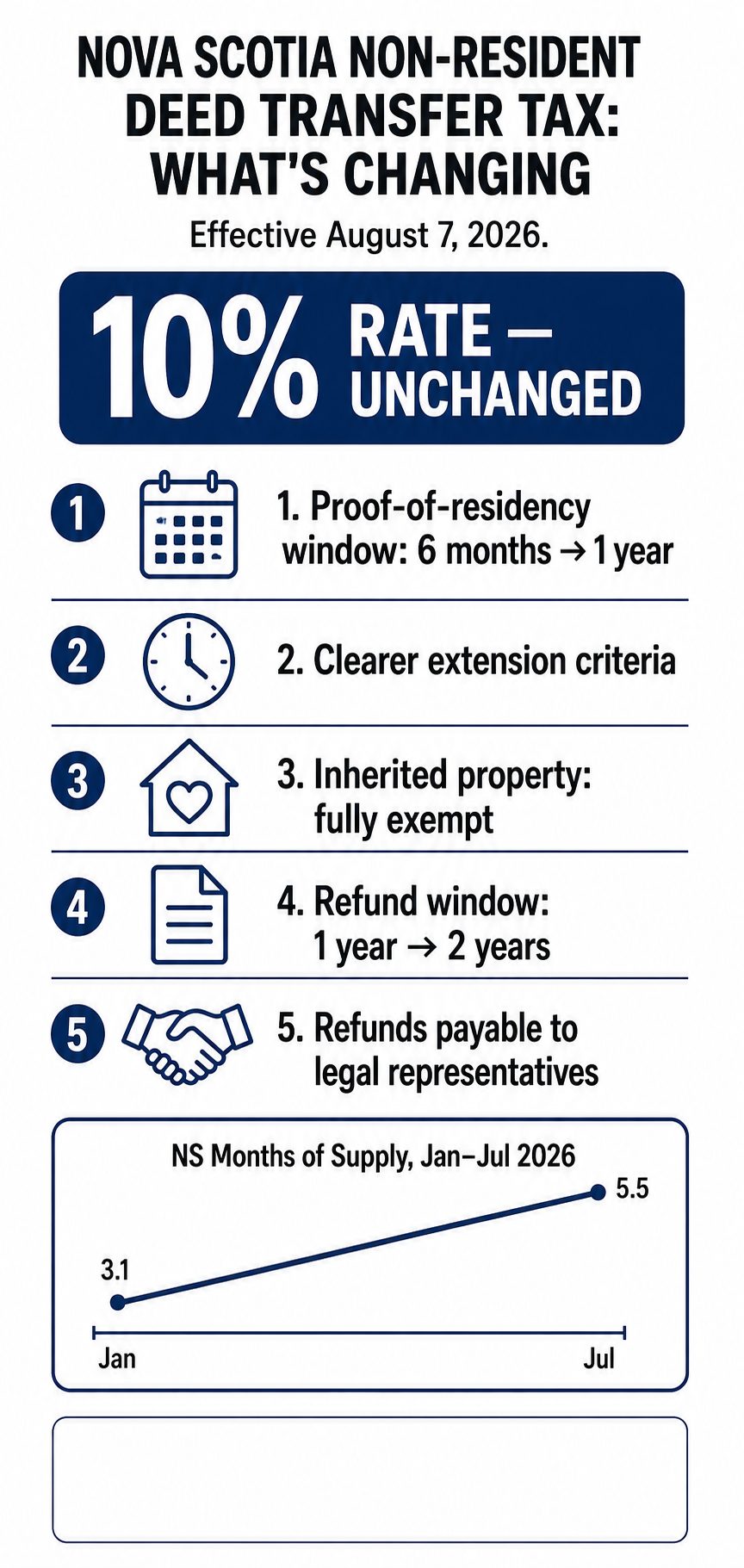
Effective for property transfers on or after August 7, 2026, the Province of Nova Scotia made five administrative adjustments to the PDTT:
-
Proof-of-residency timeline doubled – from 6 months to 1 year to show you’ve actually become a Nova Scotia resident.
-
Clearer rules for extensions – more explicit criteria for delays like construction holdups or job transitions.
-
Inheritance exemption – property willed to a non-resident after a death is now exempt from the tax outright.
-
Refund window doubled – from 1 year to 2 years to apply for a refund if you paid the tax and later qualified for an exemption.
-
Refunds payable to legal representatives – cutting down on estate and probate friction.
The tax rate stays at 10% of the greater of purchase price or assessed value, and it still applies only to non-residents buying residential property with three units or fewer (Government of Nova Scotia). As of this writing, the Province’s own PDTT web page and guidelines still reflect the pre-August 7 rules, the government has said the site, Guidelines, and Property Online interface will be updated “as soon as possible.”
Where Our Market Sits Right Now
Here’s the part that matters most for judging the timing of this move. According to our July 2026 Nova Scotia market statistics, sourced from the Nova Scotia Association of REALTORS®:
This is the fourth straight month of loosening conditions. Months supply climbed from a 3.1-month low in January and February 2026, through April’s steady price-per-square-foot climb and June’s 5.2-month reading, up to 5.5 months in July, closing in on the 6-month threshold that typically marks a balanced market. Homes are sitting longer, sellers are accepting a bit more off list price, and price growth has essentially flattened. Our Halifax price-per-square-foot analysis tells a similar story, values are holding on a per-foot basis even as headline averages soften, which is a useful reminder that this is a market shifting gears, not falling off a cliff. In short: this isn’t the red-hot, inventory-starved market of 2021–2022 that originally justified this tax. It’s a market that’s been steadily rebalancing toward buyers all year.
The Case That the Timing Makes Sense
There’s a reasonable argument that easing the administrative burden now is a sensible, low-risk move:
-
It targets a genuinely common complaint, not the controversial part. Ever since the tax doubled from 5% to 10% on April 1, 2025, the Nova Scotia Association of REALTORS® (NSAR) has argued the policy punishes people who fully intend to move here but get tripped up by circumstances outside their control, a delayed closing on their old house, a construction delay on their new one, a job start date that slips. NSAR incoming president Suzanne Gravel called the tax a “don’t come here” measure and said it “instantly gives a person the feeling they don’t want us to come there” (CBC News). Giving genuine movers a full year instead of six months and clearer criteria for extensions, directly answers that specific complaint without touching the 10% rate that raises the real political and fiscal stakes.
-
The inheritance exemption closes an obvious fairness gap. Taxing someone 10% on a home they didn’t choose to buy, they inherited it after a death in the family, was hard to defend on its face, regardless of where anyone stood on the broader tax.
-
A softening market gives the Province more room to be flexible. Back in 2022, when the tax was introduced, Nova Scotia was in the middle of an inventory crisis with months-of-supply readings well under two months in many areas and home prices spiking. Today’s 5.5-month supply and cooling prices mean there’s comparatively little risk that giving relocating buyers more time will meaningfully squeeze out local buyers, the supply-demand pressure that motivated the original policy has eased considerably.
-
It doesn’t cost the anti-speculation intent anything. Because the 10% rate is untouched, anyone who isn’t a genuine relocating resident, pure investors, seasonal buyers, still pays the full tax. The changes only extend grace to people who ultimately do become residents.
The Case That It Doesn’t Go Far Enough or Misses the Point
There’s an equally reasonable argument that this is a fairly minor fix layered on top of a policy that critics say has bigger problems:
-
It leaves the actual point of contention untouched. NSAR’s core position has never been about the paperwork deadlines, it’s that the 10% rate itself is punitive. The association collected more than 450 letters from realtors, lawyers, builders and residents calling for the tax to be repealed outright, with NSAR president Andrew Gilroy arguing it sends “a contrary message” while Nova Scotia is trying to reduce interprovincial trade barriers elsewhere (The Laker News). Administrative easing doesn’t move that needle.
-
There’s direct evidence tying the tax itself, not its paperwork, to slower activity. In Royal LePage Atlantic’s Q1 2026 market report, broker/owner Matt Honsberger said Halifax’s unusually quiet activity reflected “the cooling effects of slowing immigration, and the added cost of Nova Scotia’s interprovincial transfer tax” (Royal LePage), and a Halifax-area broker told CBC the rate doubling had a “substantial impact” on sales (CBC News). If the tax’s cost, not the deadline, is what’s discouraging buyers, longer grace periods don’t address that.
-
Economists have questioned whether the tax’s design even targets the right problem. Dalhousie economist Lars Osberg described the deed transfer tax as fundamentally “a tax on a transaction” that pushes buyers to pay more and sellers to net less, calling it primarily “a rural phenomenon” that “doesn’t touch at all the people who own apartment buildings”, the larger-scale ownership he sees as the bigger driver of the housing shortage (CityNews Halifax). Cape Breton University’s Catherine Leviten-Reid, while more supportive of the tool in principle, noted Nova Scotia’s rate is still comparatively modest next to foreign-buyer taxes in B.C. and Ontario, and questioned how much of a dent a small non-resident-ownership share (roughly 3.6–4%) can really make (CBC News).
-
Rural communities flagged concerns the administrative tweak doesn’t resolve. Richmond County council, in the Strait of Canso area, wrote to the Province and the Nova Scotia Federation of Municipalities warning the tax increase could hurt local housing markets and discourage former Nova Scotians from returning home (CBC News) a concern about the rate and reach of the tax, not its filing deadlines.
-
The tax’s own revenue has already underperformed estimates. Nova Scotia’s Public Accounts noted deed transfer tax revenue came in $1.3 million (10.5%) below estimate in a recent fiscal year, attributed to lower market values on properties bought by non-residents. Extending the refund window to two years adds more delay and uncertainty to an already unpredictable revenue line, without addressing why non-resident purchase activity, and the tax base itself, has been softer than forecast.
What This Means for Our Clients
For anyone we’re working with who’s buying here while still living elsewhere with a genuine plan to relocate: this is unambiguously good news. A full year (instead of six months) to establish residency, clearer rules on extensions for things like construction delays, and a two-year refund window all reduce the odds of getting caught by the tax on a technicality rather than genuine intent. The inheritance exemption is also a meaningful, welcome fix for families dealing with an estate.
If you’re one of these relocating buyers, it’s worth pairing this extra breathing room with the rest of your financing homework. Our guide to understanding the 2026 mortgage stress test walks through what lenders will actually qualify you for, and if this is your first home in the province, our breakdown of how to stack federal and provincial first-time buyer programs and Nova Scotia’s 2% down payment program can meaningfully offset the extra costs of a move. And if you’re weighing a condo against a single-family home once you land here, our condo vs. house comparison for Halifax-Dartmouth is a good next read. You can also get a sense of what a comparable property might cost you by browsing our current listings, and if you’re selling a Nova Scotia property as part of your move, a free home valuation is a quick way to see where you stand.
For clients who were hoping this signalled a rollback of the 10% rate itself, it doesn’t. If cost, not paperwork, was the deciding factor for a non-resident buyer, this change won’t move them off the fence.
Bottom Line
Judged against where our market sits today, months of supply at a 13-month high, prices easing, homes taking longer to sell, easing the administrative side of this tax is a reasonable, fairly low-risk move that responds to years of legitimate complaints about rigid deadlines, without reopening the much bigger fight over the rate itself. Whether it’s “the right call” really depends on what you think the tax is for: if the goal is fairness and reducing unnecessary friction for genuine movers, this is a clear improvement. If the goal is meaningfully helping affordability and supply for Nova Scotians, the evidence and expert commentary above suggest the administrative tweaks are unlikely to be the difference-maker, the rate and design of the tax, which several economists and industry voices say targets a small and possibly not-that-impactful slice of the market, remain exactly as they were.
Related reading from Century 21 Optimum Realty:
Sources:
-
Government of Nova Scotia — Non-resident Provincial Deed Transfer Tax
-
Century 21 Optimum Realty — Nova Scotia Real Estate Market Statistics, July 2026
-
The Laker News — “NSAR want province to repeal provincial deed transfer tax,” March 13, 2025
-
CBC News — “Does Nova Scotia’s hiked deed transfer tax help or hurt housing?” April 16, 2025
-
CBC News — “New taxes on non-Nova Scotian homeowners met with mixed reviews,” March 2023