Facebook
 X
 Pinterest
 Copy Link
Will the Bank of Canada Raise Rates on October 28? What Nova Scotia Buyers and Sellers Should Know
By Rob Lough, Broker/Owner | Century 21 Optimum Realty | October 22, 2026
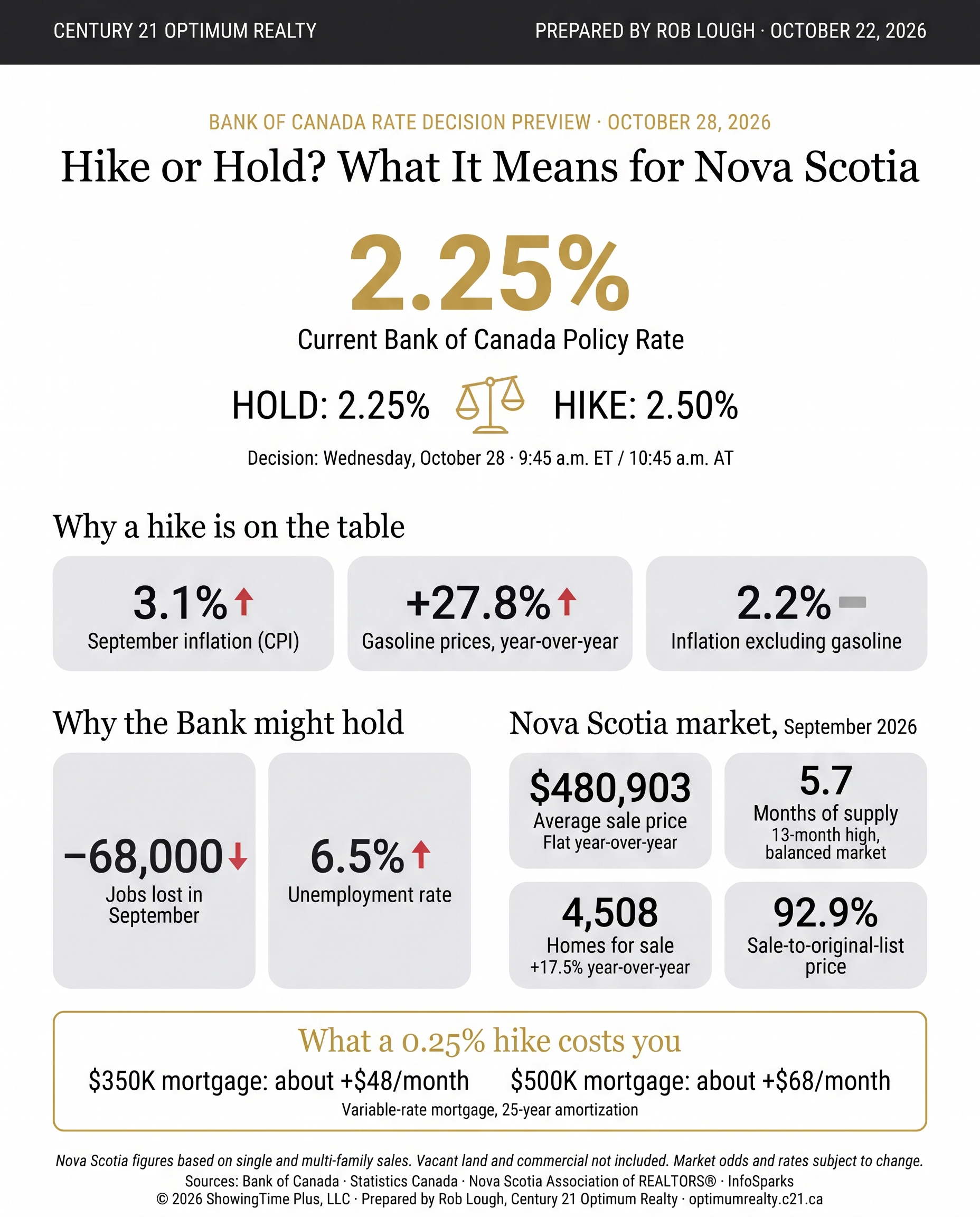
The Bank of Canada announces its next interest rate decision on Wednesday, October 28, and for the first time since 2023, a rate hike is a real possibility. The policy rate has sat at 2.25% for seven straight decisions. Just two weeks ago, most forecasters expected that streak to continue.
That changed fast. After a weak September jobs report, markets put the odds of an October hike at roughly one in four. Then the Governor spoke, and within days money markets had swung to pricing in a strong chance of a quarter-point increase on October 28.
Here’s why expectations flipped, the case on both sides, and what it means for Nova Scotia buyers and sellers heading into the fall market.
Why Rate Expectations Flipped
Inflation ticked up, but mostly because of gas. September’s Consumer Price Index came in at 3.1% year-over-year, up from 3.0% in August and just under the 3.2% economists expected. Gasoline prices were up 27.8% from a year ago and did most of the lifting. Strip out gasoline, and inflation was 2.2%, right around the Bank’s 2% target.
Core inflation actually eased. The Bank’s preferred core measures moved lower: trimmed mean at 1.8%, median at 1.9% and common at 2.4%.
The Governor changed the conversation. The trigger for the repricing was Governor Tiff Macklem’s warning that the Bank will raise its inflation forecast “significantly” in its October Monetary Policy Report because of higher oil prices.
Bond yields followed. Canada’s 10-year bond yield jumped about 11 basis points to 3.94% on October 19. That matters to homebuyers because fixed mortgage rates track bond yields, not the Bank of Canada’s policy rate. The Big 6 banks have already raised their fixed mortgage rates by 10 to 50 basis points since early September.
The Case for a Hike
- Oil-driven inflation could stick. If oil holds near $100 a barrel, the Governor’s concern is that inflation drifts higher from 3% rather than settling back toward 2%.
- The Bank wants to stay ahead of expectations. Raising rates early is the Bank’s way of signalling it won’t let a temporary price shock turn into lasting inflation.
The Case for Holding
- The 3.1% headline is an energy story. With gasoline removed, inflation is 2.2%, and core measures are easing, not rising.
- The job market is softening. Canada lost 68,000 jobs in September, and the unemployment rate rose to 6.5%.
- Rate hikes can’t fix an oil shock. Raising rates won’t lower the price of oil. It would squeeze household budgets that are already absorbing higher fuel costs.
Both arguments are reasonable, which is why this decision is genuinely close.
What It Means for Nova Scotia Real Estate
Whatever the Bank decides, it lands on a Nova Scotia market that has already shifted. Our Nova Scotia Real Estate Market Statistics September 2026 report shows where things stand:
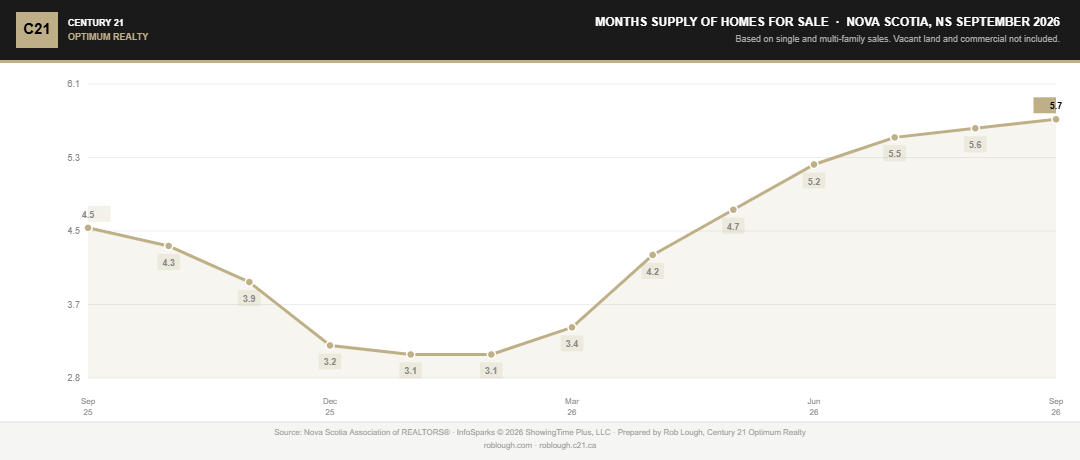
- 5.7 months of supply, a 13-month high and right at the six-month line that marks a balanced market
- 4,508 homes for sale, up 17.5% year-over-year, with inventory rising in nine of the last ten months
- Average sale price of $480,903, essentially flat compared with last year
- 92.9% of original list price on average, meaning many sellers are reducing before they sell
- 53 average days on market, with 828 sales, down 9.9% year-over-year
Looking ahead, CREA’s latest forecast has Nova Scotia sales down 7.7% in 2026. RBC Economics has named Halifax among the markets that are stabilizing, with resales climbing since April.
Nova Scotia Real Estate Market Statistics September 2026 Average Days on Market
The bottom line: a rate hike doesn’t change the inventory picture. It changes the monthly payment picture.
What a Quarter-Point Hike Costs You
Here’s the simple math on a variable-rate mortgage with a 25-year amortization:
| Mortgage balance | Extra cost per month (+0.25%) | Extra cost per year |
|---|---|---|
| $350,000 | about $48 | about $575 |
| $500,000 | about $68 | about $818 |
Real money, but not a crisis for most households. If you’re shopping for a mortgage, the bigger issue is qualifying: the federal stress test still requires you to qualify at the higher of 5.25% or your contract rate plus 2%. Our guide to Understanding the 2026 Mortgage Stress Test walks through how that works. To run your own numbers, try our mortgage calculator.
For Buyers
Buyers have the most negotiating room Nova Scotia has seen in over a year. More listings, longer days on market and sellers accepting below their original asking price all work in your favour. The risk is borrowing costs. If you’re planning to buy this fall, get pre-approved now. Most pre-approvals hold a rate for 90 to 120 days, which protects you if fixed rates keep climbing.
For Sellers
Price for the market you’re in, not the one from two years ago. With 5.7 months of supply and sellers averaging 92.9% of their original list price, overpricing costs you time and leverage. Higher rates can shrink a buyer’s budget, which makes accurate pricing from day one even more important. Start with a free market evaluation based on current comparable sales.
What to Watch on October 28
The Bank releases its decision at 9:45 a.m. Eastern (10:45 a.m. Atlantic), together with its quarterly Monetary Policy Report. The updated inflation forecast may matter more than the rate decision itself. Listen for how much weight the Bank gives oil-driven inflation compared with the softening job market. That balance will shape the path for December and into 2027.
I’ll follow up after the announcement with what the Bank decided and what it means for Nova Scotia.
Hike or Hold, the Fundamentals Stay the Same
Rates move overnight. Nova Scotia’s market fundamentals don’t. Inventory is up, the market is balanced, and pricing discipline matters for both buyers and sellers. If you’re weighing a move this fall, our team at Century 21 Optimum Realty can help you sort out what the October 28 decision means for your situation.
Thinking about selling? Find out what your home is worth today.