Facebook
 X
X
 Pinterest
 Copy Link
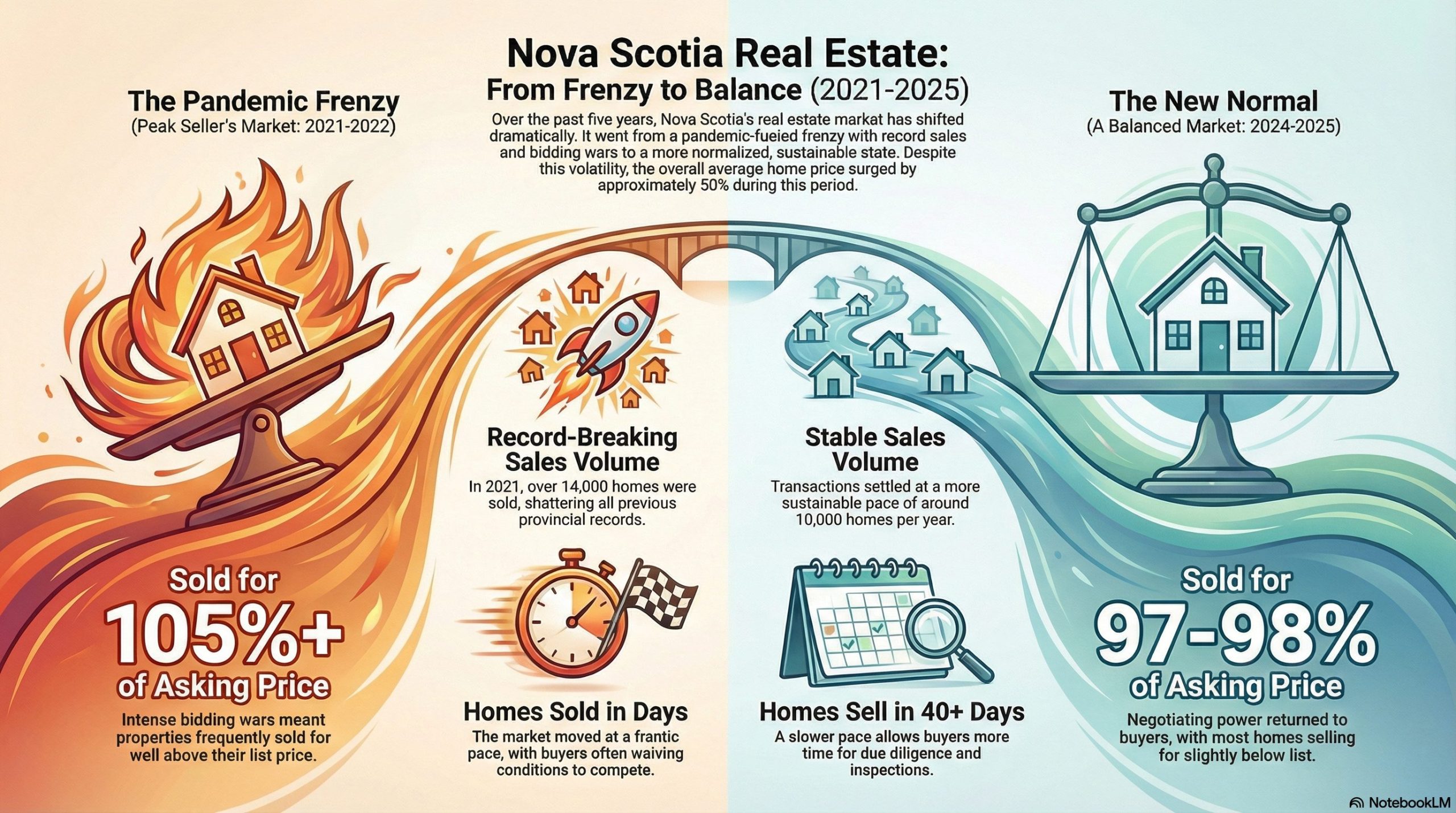
Five Years of Nova Scotia Real Estate Market Analysis: Transformation from (2021-2025)
By Rob Lough, Broker/Owner at Century 21 Optimum Realty
Nova Scotia’s residential real estate market has undergone a remarkable transformation over the past five years. From the pandemic-fueled frenzy of 2021 to today’s more balanced conditions, the province has experienced dramatic shifts in pricing, sales volume, and market dynamics. Interested in seeing the end of year market stats for 2025?
This comprehensive analysis examines the key trends that have shaped the market, providing valuable insights for both buyers and sellers navigating Nova Scotia’s evolving real estate landscape. For an even broader view, see our Ten Years of Nova Scotia Real Estate Market Analysisers.
The most striking feature of Nova Scotia’s real estate market over the past five years has been the sustained price appreciation. Average home prices have surged approximately 50% since early 2021, transforming the province’s housing affordability landscape.
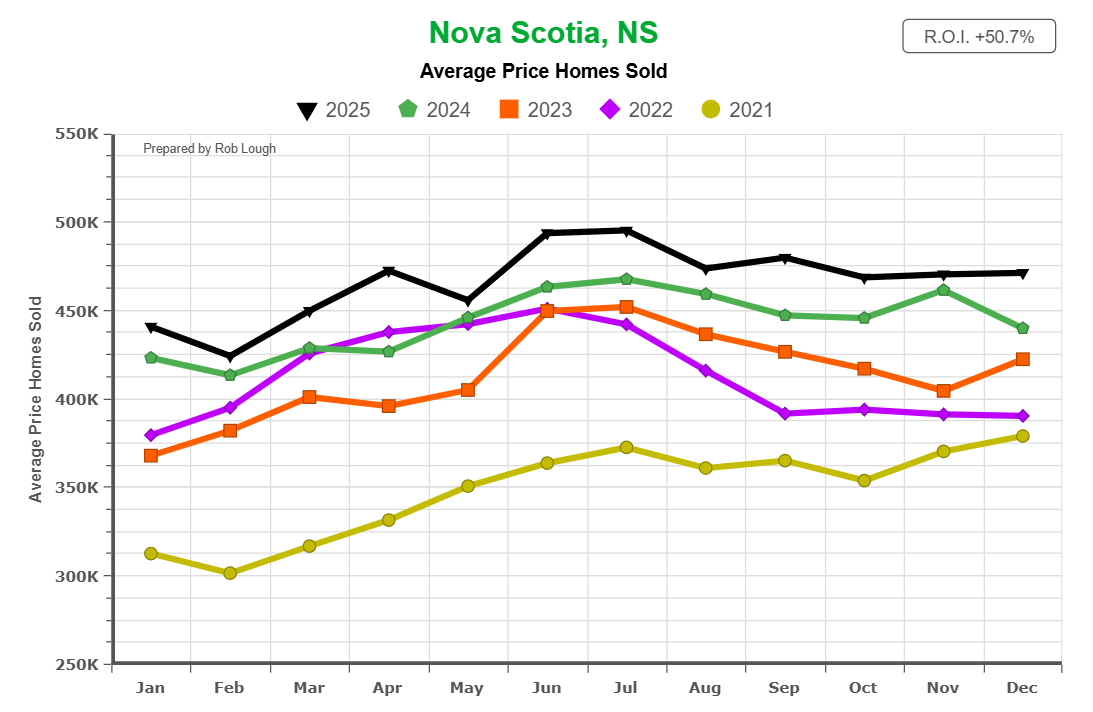
Nova Scotia average home sale prices by month 2021-2025 with 50.7% ROI showing steady price appreciation from $312K in 2021 to $485K in 2025
From the low $300,000s in January 2021, the average sale price has climbed to approximately $485,000 by the end of 2025. This represents a remarkable 50.7% return on investment for homeowners who purchased at the start of this period.
While price growth has moderated from the explosive gains of 2021–2022, values remain elevated. Year-over-year, 2025 prices are up roughly 5% from 2024 levels and nearly 40% above 2020 benchmarks. Despite higher mortgage rates and affordability concerns, the market has maintained its upward trajectory.
What This Means for Buyers: While prices remain significantly higher than five years ago, the pace of appreciation has slowed considerably. This creates a more sustainable market environment where buyers have time to make informed decisions without the pressure of rapid price escalation. However, waiting for substantial price corrections may not be a viable strategy, as the market has demonstrated resilience despite higher borrowing costs.
What This Means for Sellers: Homeowners who purchased in 2020 or earlier have seen exceptional equity gains. While the days of automatic multiple offers and above-asking sales are largely over, properly priced homes continue to sell at historically elevated values. The key is realistic pricing aligned with current market conditions rather than peak 2022 expectations.
Sales Volumes Normalize After Record-Breaking 2021
The pandemic era triggered unprecedented transaction volumes across Nova Scotia. In 2021, the province recorded over 14,000 residential sales, shattering previous records as buyers rushed to secure properties amid rock-bottom interest rates and lifestyle changes driven by remote work.
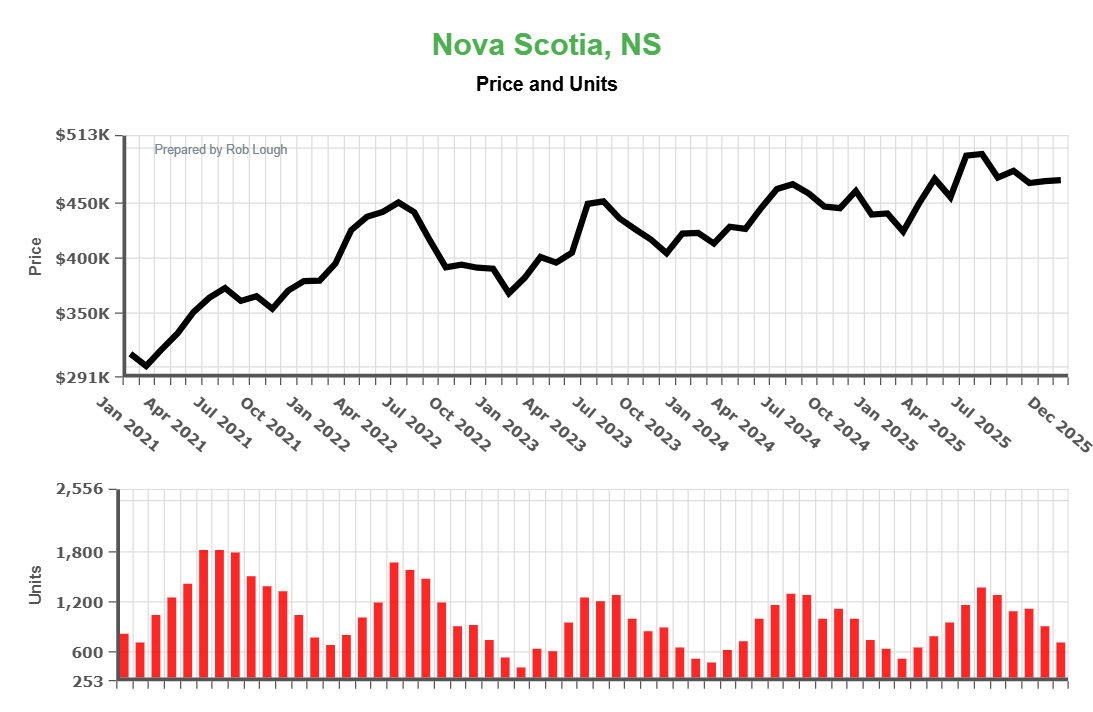
Nova Scotia average home prices and units sold 2021-2025 displaying price increase from $291K to $485K with inverse relationship between price growth and sales volume
However, the market cooled dramatically in 2022 and 2023 as the Bank of Canada implemented aggressive rate hikes. Sales volumes plummeted to their lowest levels since before the pandemic, with many potential buyers sidelined by reduced affordability and economic uncertainty.
By 2024-2025, transaction volumes stabilized at just over 10,000 units annually. While this represents a significant decline from 2021’s peak, it’s important to note that total dollar volume has remained robust due to higher average prices. The market has essentially traded quantity for quality, with fewer but more valuable transactions.
What This Means for Buyers: Lower transaction volumes indicate reduced competition compared to the frenzied conditions of 2021-2022. Buyers now have more time to conduct thorough inspections, negotiate terms, and make conditional offers. The return to more normalized sales volumes has shifted power back toward buyers after years of seller dominance.
What This Means for Sellers: With fewer buyers actively searching, sellers must be more strategic in their approach. Professional photography, competitive pricing, and proper marketing are no longer optional but essential. The days when any listing would generate immediate interest are over—homes must be well-presented and realistically priced to attract today’s more selective buyers.
Traditional Seasonal Patterns Re-Emerge
One of the most notable developments in recent years has been the return of traditional seasonal patterns to the Nova Scotia market. During the pandemic boom of 2021, market activity remained elevated year-round, defying historical norms.
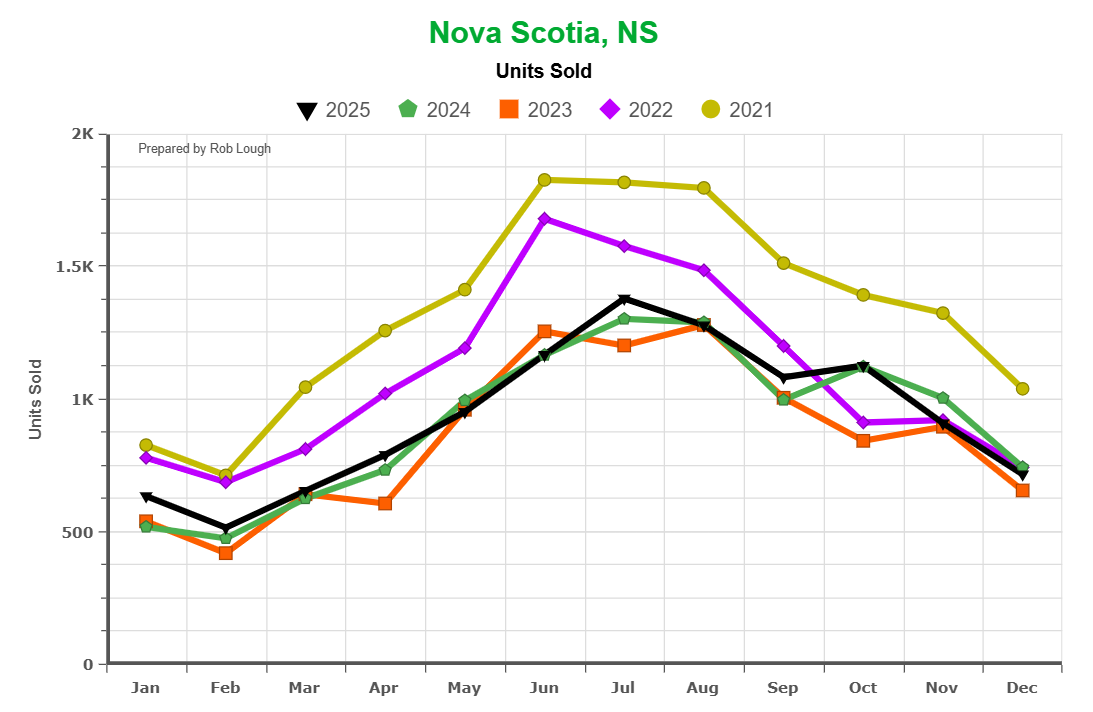
Nova Scotia monthly home sales by year 2021-2025 comparing seasonal patterns with peak sales in June-August and lowest activity in winter months
The data reveals strong seasonal peaks in late spring and summer across all five years, with 2021 showing the most pronounced spikes—often reaching 1,700-1,800 units per month. However, the seasonal amplitude has moderated in subsequent years as the market cooled.
Winter troughs have become more pronounced since 2022, particularly in January and February. This reflects the return to more rate-sensitive, deliberate buyer behavior rather than the year-round urgency that characterized the early pandemic period.
The traditional spring market has reasserted itself as the prime selling season, with buyers actively house-hunting as weather improves and families plan moves around the school calendar.
What This Means for Buyers: Strategic timing can provide advantages in today’s market. Shopping during the slower winter months may yield more negotiating leverage and less competition. Conversely, spring and summer offer the widest selection of available properties. Understanding these seasonal dynamics allows buyers to align their search strategy with their priorities—whether that’s selection or negotiating power.
What This Means for Sellers: Listing timing matters more now than during the pandemic boom. Properties listed in late winter or early spring typically benefit from pent-up buyer demand and face less competition from other sellers. However, sellers with flexibility should avoid listing during peak winter months unless they’re prepared for longer market times and potentially more aggressive negotiations.
Market Time Extends as Power Shifts
Perhaps no metric better illustrates the market’s transformation than average days on market (DOM). During the height of the pandemic boom in 2021-2022, well-presented homes often sold within days, sometimes with multiple offers on the same day of listing.
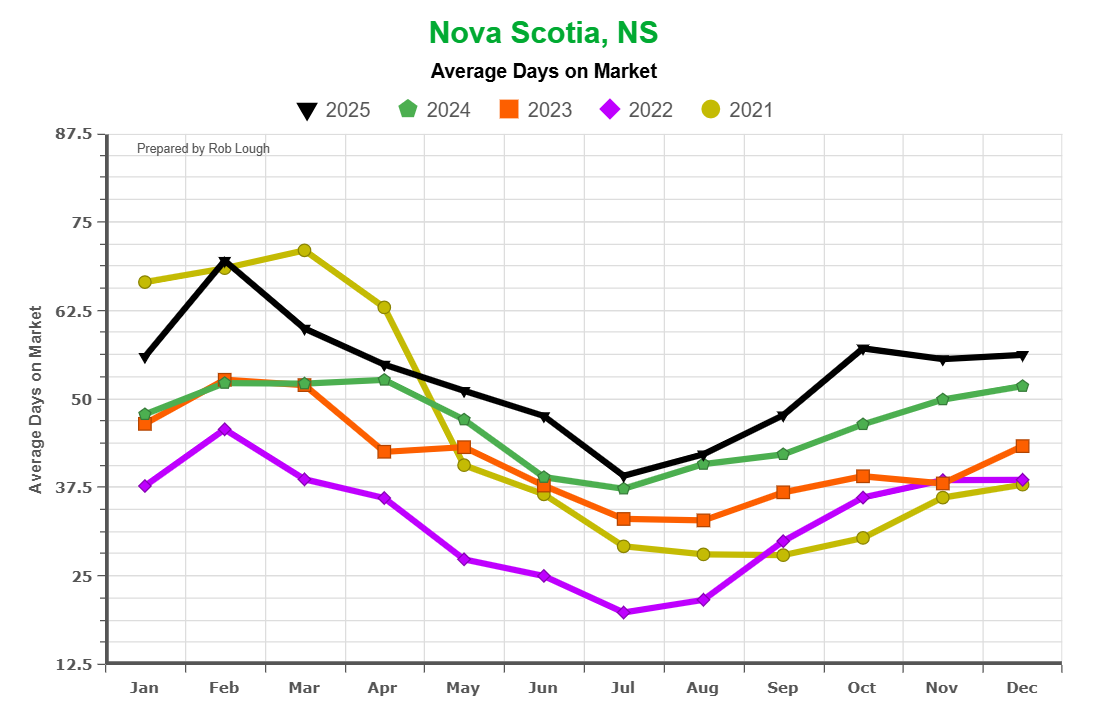
Nova Scotia average days on market 2021-2025 comparing years showing fastest sales of 20-30 days in summer 2022 to current 50-56 day average in 2025
Fast forward to 2025, and the picture has changed dramatically. Current data shows average DOM hovering in the high 40-day range—significantly longer than the frenzied early pandemic period but still reasonable by historical standards.
This extended market time reflects buyers’ restored ability to conduct thorough due diligence, compare multiple properties, and negotiate terms. The rushed, waive-all-conditions approach that defined 2021-2022 has given way to more conventional transaction timelines.
Complementing this trend, the average sold-to-ask ratio has drifted downward to the 97-98% range by late 2025. This represents a significant shift from 2021-2022 when properties routinely sold at or above asking price. Today’s market sees more conditional offers, fewer bidding wars, and greater scrutiny from increasingly selective buyers.
What This Means for Buyers: Extended market times and declining sold-to-ask ratios create opportunities for buyers to negotiate. Don’t be afraid to make offers below asking price on properties that have been listed for several weeks. Include standard conditions like financing and inspection, which are once again becoming the norm. Take time to conduct proper due diligence—the pressure to decide immediately has largely dissipated.
What This Means for Sellers: Realistic pricing has never been more critical. Overpriced homes sit on the market longer and often sell for less than they would have with competitive initial pricing. Work with your realtor to analyze recent comparable sales and price accordingly from day one. Be prepared to negotiate and accept reasonable conditions—the unconditional, above-asking offers of 2021-2022 are largely a thing of the past.
Market Value Remains Elevated Despite Volatility
While unit sales have declined from their 2021 peak, the total value of real estate transactions tells a more nuanced story. The monthly value of sales has remained relatively stable, fluctuating between seasonal highs and lows rather than showing sustained decline.
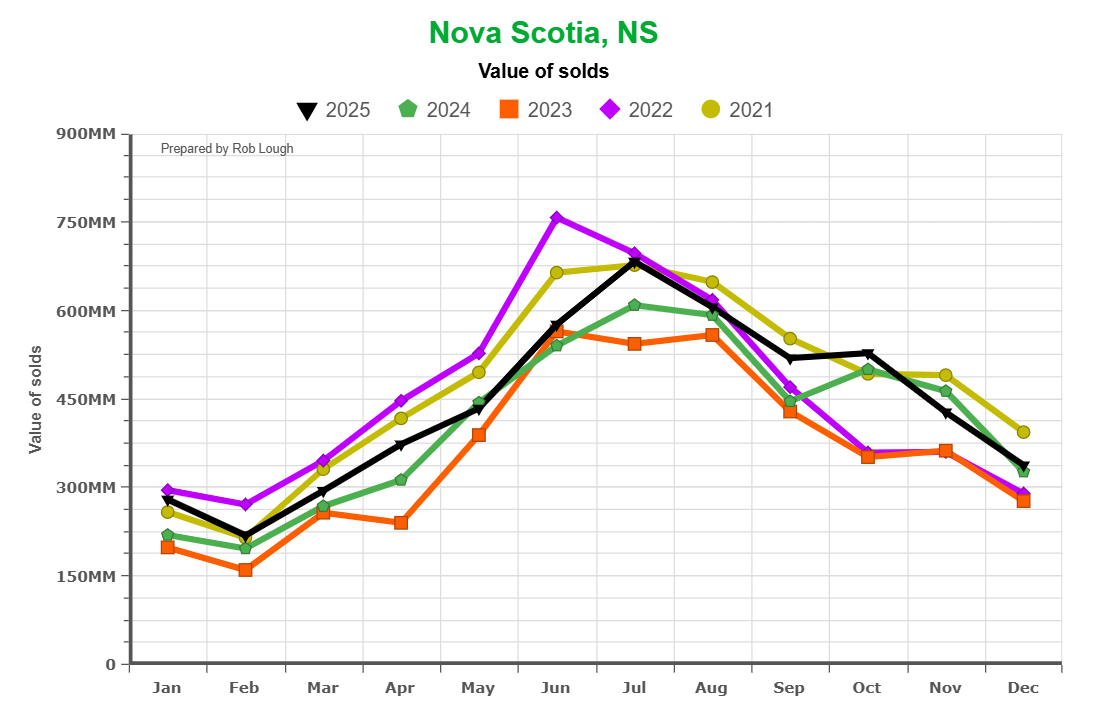
Nova Scotia real estate value of sales 2021-2025 showing monthly transaction volumes ranging from $150M to $750M with seasonal peaks in spring and summer
Peak months in 2022 saw transaction values exceeding $750 million, while even the slower periods of 2023-2025 typically generated $300-400 million in monthly sales. This consistency in dollar volume, despite lower unit sales, underscores how rising prices have offset declining transaction counts.
The data reveals a market that has shifted from high-volume, moderate-price transactions to lower-volume, high-price transactions. This evolution reflects both the maturation of Nova Scotia’s real estate market and the province’s ongoing challenge with housing affordability.
The Inverse Relationship: Prices Rise as Volume Falls
A striking feature of the past five years has been the inverse relationship between transaction volumes and average prices. As unit sales declined from their 2021 peak, prices continued their upward march with only brief plateaus.
Nova Scotia average home prices and units sold 2021-2025 displaying price increase from $291K to $485K with inverse relationship between price growth and sales volume
This pattern reflects a fundamental characteristic of Nova Scotia’s market: persistent demand meeting limited supply. Even as higher interest rates and reduced affordability pushed some buyers to the sidelines, the remaining pool of qualified buyers competed for a still-constrained inventory of available homes.
The province’s ongoing population growth, driven by both interprovincial migration and international immigration, has maintained upward pressure on prices even as transaction volumes normalized. This demographic tailwind shows no signs of abating, suggesting continued support for home values in the medium term.
Negotiating Power Returns to Buyers
The sold-to-ask ratio serves as an excellent barometer of negotiating leverage in any market. The five-year data reveals a clear evolution from extreme seller’s market conditions to today’s more balanced environment.
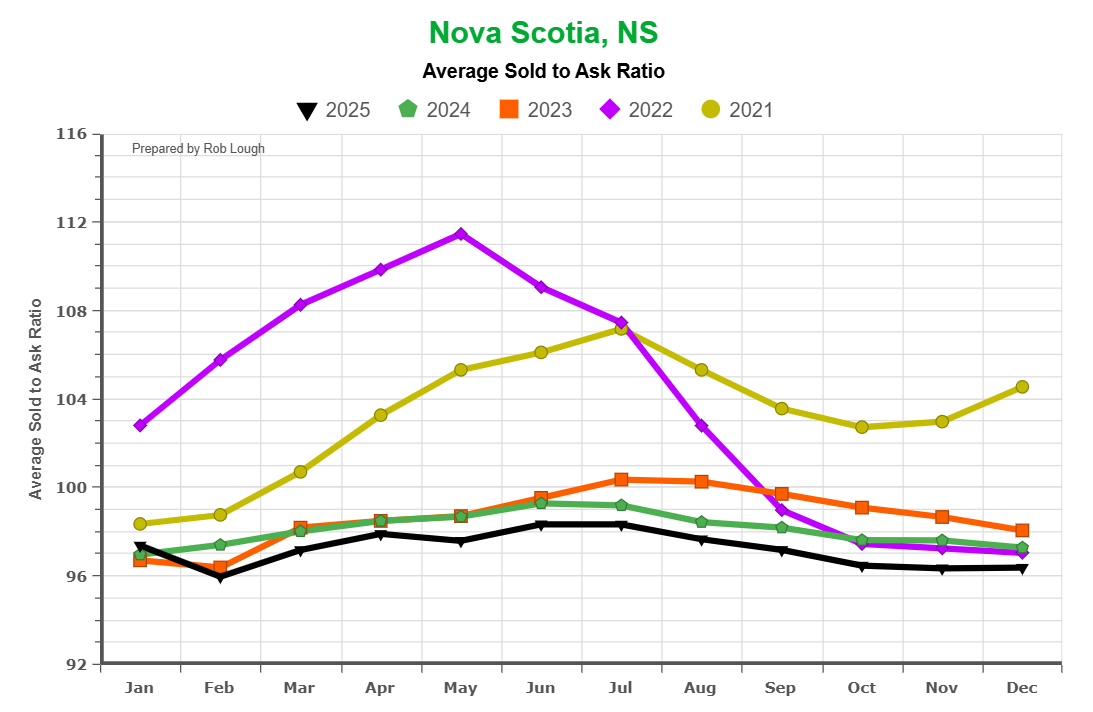
Nova Scotia average sold-to-ask ratio 2021-2025 showing decline from 112% peak in 2022 to 97-98% range in 2025 indicating return to balanced market conditions
In 2021 and 2022, the ratio frequently exceeded 105%, with peak months seeing properties sell for 107-112% of asking price. This reflected the bidding war environment where desperate buyers competed against multiple offers, often waiving conditions to secure properties.
By contrast, 2024 and 2025 have seen ratios stabilize in the 97-98% range. Properties are selling, but generally at slight discounts to asking price. This normalized ratio indicates that sellers are pricing optimistically (as they traditionally do) and buyers are successfully negotiating reductions during the transaction process.
The return to sub-100% ratios represents one of the most significant shifts in market dynamics. It signals that buyers have regained negotiating leverage after years of being price-takers in a seller-dominated market. However, the fact that ratios remain above 95% suggests the market hasn’t swung to a buyer’s market in the extreme sense—rather, it has achieved a more balanced equilibrium.
What This Means for Buyers: The current sold-to-ask environment favors buyers who do their homework. Make offers based on comparable sales and property condition, not just asking price. Most properties are selling for 2-3% below asking, so don’t be intimidated by list prices. Use professional home inspections and appraisals as negotiating tools if issues emerge. The key is to be reasonable but assertive in your offers.
What This Means for Sellers: Gone are the days of pricing 10% above market value and still receiving above-asking offers. Today’s successful sellers price at or slightly above recent comparable sales, not the peak values from 2022. Remember that your asking price is the starting point for negotiations, and most deals close at 97-98% of list. Price strategically to attract buyer interest while leaving minimal room for negotiation.
Looking Ahead: A Stable, Mature Market
As we move into 2026, Nova Scotia’s real estate market presents a dramatically different landscape than the frenzied conditions of just four years ago. The transformation from seller’s market to balanced conditions represents a return to normalcy after an unprecedented pandemic-era boom.
Several factors support continued market stability:
Ongoing population growth through interprovincial migration and immigration continues to drive housing demand across the province. Nova Scotia remains one of the fastest-growing provinces in Canada, with new residents attracted by relative affordability, quality of life, and economic opportunities.
Interest rates have stabilized after the aggressive hiking cycle of 2022–2023, with some economists predicting modest cuts in 2026. This could provide a modest boost to buyer affordability and transaction volumes without triggering another unsustainable boom. That price run has real consequences, new NSAR data shows 77% of Nova Scotians now consider housing unaffordable, even as 73% of non-owners say they still want to own.reased, it remains insufficient to fully address the housing shortage accumulated over decades of underbuilding.
The consensus forecast points to modest price appreciation of 2-4% annually over the next few years, with sales volumes likely remaining in the 10,000-11,000 unit range. This represents a healthy, sustainable market rather than the speculative environment of 2021-2022.
What This Means for Buyers: The current environment offers the best conditions for buyers since before the pandemic. Competition has eased, sellers are negotiable, and you can make informed decisions without artificial time pressure. However, waiting for significant price declines is likely a losing strategy, demographic trends and supply constraints suggest continued modest appreciation. If you’re financially prepared and have found the right property, current market conditions favor action over waiting.
What This Means for Sellers: While market conditions have moderated from the extreme seller’s market of 2021-2022, well-priced, well-presented homes continue to sell successfully. The key is adjusting expectations to current reality rather than peak pandemic conditions. Work with experienced real estate professionals who understand local market nuances, invest in proper staging and marketing, and price competitively from the start. The fundamental strength of Nova Scotia’s real estate market remains intact—it just requires more professional execution than the anything-sells environment of recent memory.
The Bottom Line
Nova Scotia’s real estate journey from 2021 to 2025 tells the story of a market that experienced extraordinary conditions and has gradually normalized into a sustainable equilibrium. Prices have risen approximately 50% over five years, unit sales have declined from record highs but stabilized at healthy levels, and market dynamics have shifted from extreme seller’s market to balanced conditions.
For buyers and sellers navigating today’s market, understanding these trends is essential for making informed decisions. The frenzied bidding wars and instant sales are gone, replaced by a more deliberate, traditional real estate environment where due diligence, strategic pricing, and professional representation matter once again.
Whether you’re considering buying your first home, comparing a condo to a house, trading up to accommodate a growing family, or selling to downsize or relocate, the current market offers opportunities for those who approach it with realistic expectations and sound strategy. At Century 21 Optimum Realty, we’re committed to helping you navigate Nova Scotia’s evolving real estate landscape with expert guidance tailored to your unique circumstances.
Ready to buy or sell in Nova Scotia? Contact the experienced team at Century 21 Optimum Realty for expert guidance tailored to your unique real estate goals.
Related Resources
- Nova Scotia Housing Market 2025: A Comprehensive Analysis of Home Prices and Trends
- Ten Years of Nova Scotia Real Estate Market Analysis
- Nova Scotia Real Estate Market Statistics 2025: A Year of Transition
- Canadian Real Estate 2025: Why Nova Scotia’s Housing Market Outshines Major Cities
- Halifax Real Estate Market Insights: 4 Surprises
- Halifax & Bedford Housing Boom
- Nova Scotia Real Estate Market Stats – January 2026