Facebook
 X
X
 Pinterest
 Copy Link

Nova Scotia Real Estate Stats for November 2025
As 2025 draws to a close, it’s time to take stock of Nova Scotia’s real estate market performance over the past twelve months. The data tells a compelling story of seasonal rhythms, strong price growth, and a market that’s finding its sustainable pace after years of pandemic-era volatility.
Total Sales Volume: Classic Seasonal Pattern Emerges
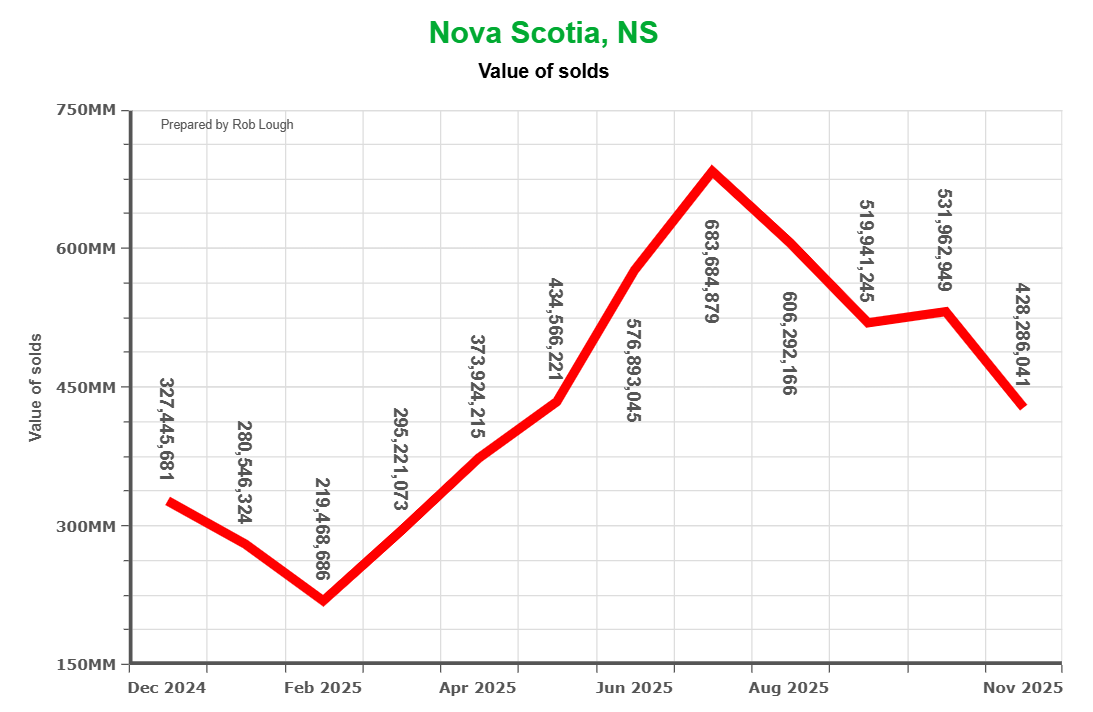
Nova Scotia Real Estate Stats November 2025 value of sold
The total dollar volume of real estate transactions followed a predictable arc throughout the year. Starting at $327 million in December 2024, the market hit its lowest point in February at just $219 million, a typical winter trough reflecting harsh weather and post-holiday financial caution.
Spring brought renewed energy, with March climbing to $295 million and April surging to $373 million. The market peaked in midsummer, with July recording an impressive $683 million in transactions, more than triple the February low. This summer surge accounted for a disproportionate share of annual activity, with May through August consistently exceeding $500 million monthly.
As expected, fall brought gradual cooling. By November, monthly sales had settled back into the mid-$400 million range at $428 million. While down from summer highs, this represents healthy ongoing activity and demonstrates the market’s underlying strength heading into winter. This pattern aligns with our October 2025 market analysis, which showed clear seasonal transitions taking hold.
Units Sold: Summer Dominance Clear
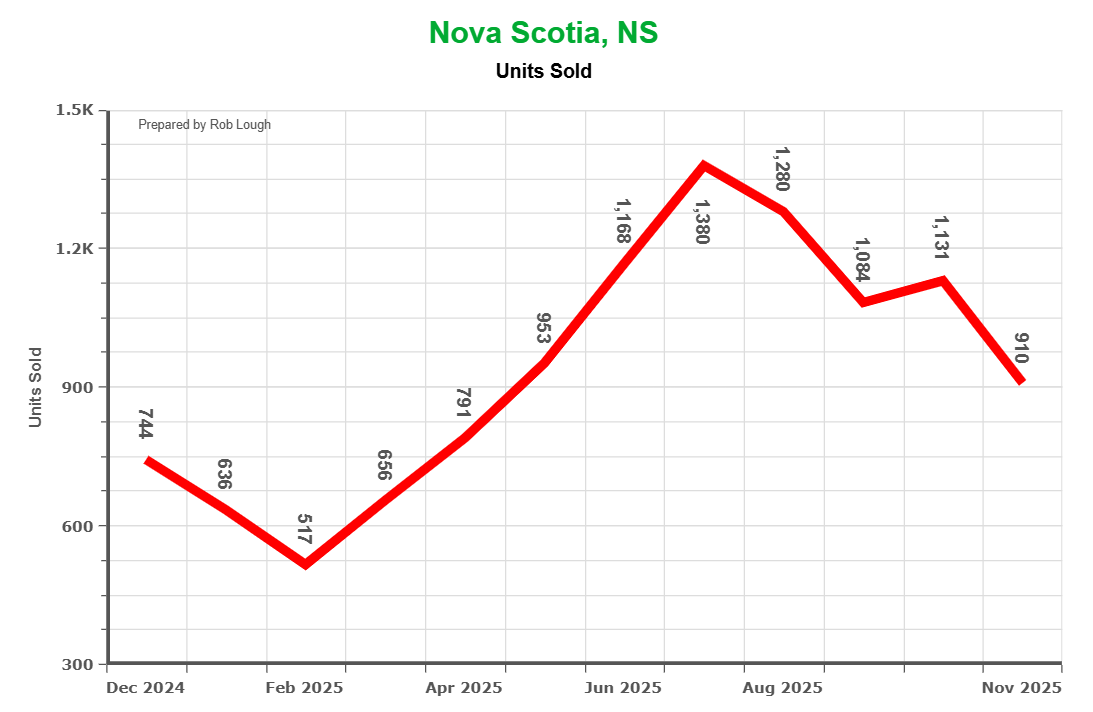
Nova Scotia Real Estate Stats for November 2025 Units Sold
The number of homes changing hands mirrored the dollar volume pattern. February’s winter low of 517 units sold gave way to steady spring acceleration, with April recording 791 sales and May jumping to 953 transactions.
Summer delivered peak activity: June reached 1,168 sales, July hit the annual high at 1,390 units, and August maintained momentum with 1,280 transactions. These four months (May through August) accounted for more than 40% of annual sales, underscoring how critical proper timing is for sellers looking to maximize exposure and competition.
The fall cooldown was orderly rather than abrupt, with September recording 1,084 sales, October at 1,131, and November closing at 910 units. These figures remained well above winter lows, suggesting continued buyer confidence and healthy market fundamentals.
Average Days on Market: Speed Varies Dramatically by Season
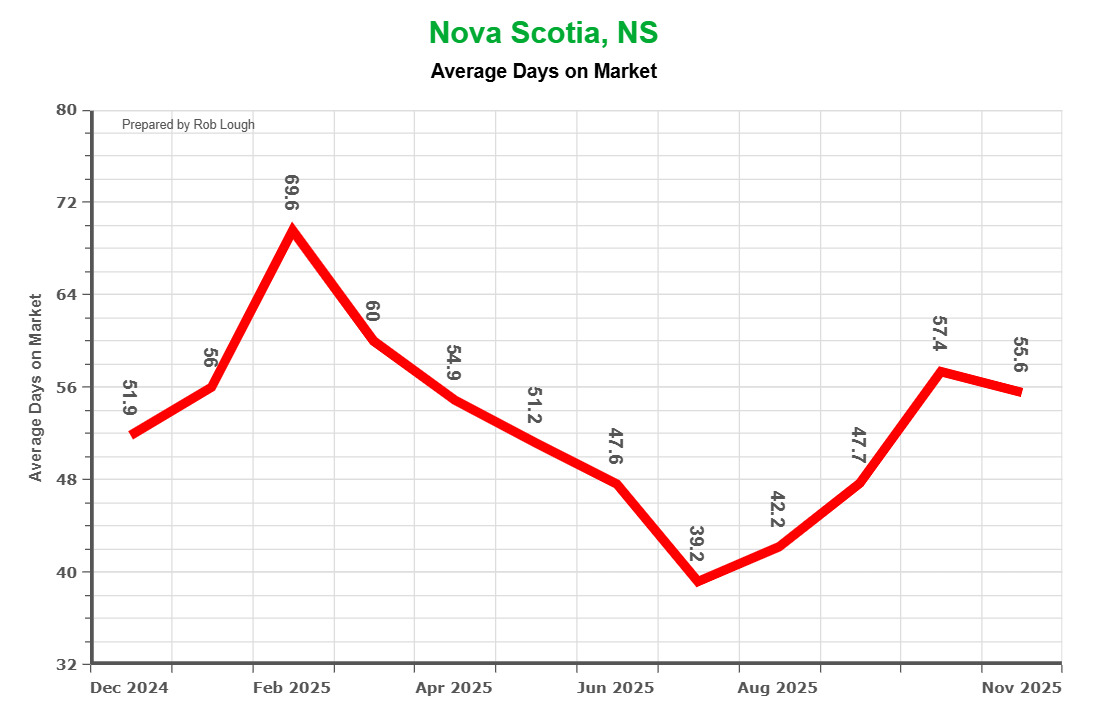
Nova Scotia Real Estate Stats for November 2025 Average Days on Market
Days on market proved highly seasonal, starting at 51.9 days in December and spiking to the year’s slowest point in February at 69.6 days. This winter peak reflects reduced buyer urgency, weather challenges, and limited inventory turnover.
The market accelerated through spring, improving to 60 days in March and 54.9 days by April. Summer brought the fastest conditions: June averaged 47.6 days, while July hit the year’s low at just 39.2 days, a true seller’s market where well-priced homes received multiple offers quickly.
Fall saw gradual lengthening: September at 47.1 days, October extending to 57.4 days, and November at 55.6 days. This represents a healthy middle ground, faster than winter but without summer’s frenzy, creating balanced conditions for both buyers and sellers.
Average Home Prices: Strong 6.9% Annual Growth
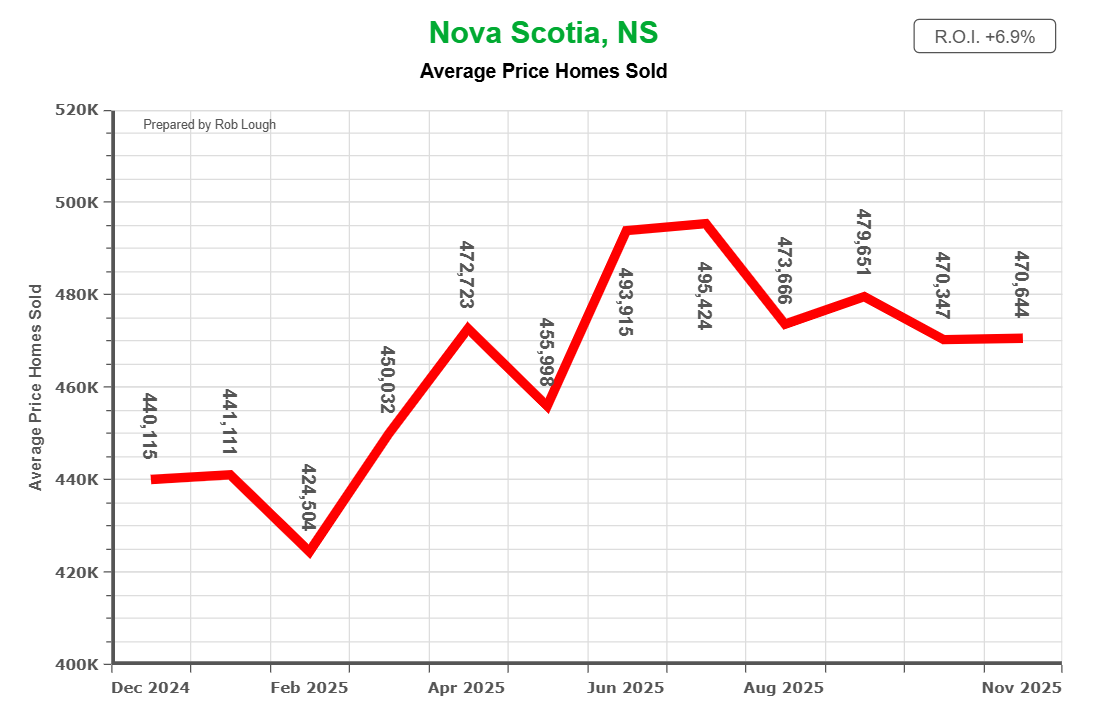
Nova Scotia Real Estate Stats for November 2025 Average Price of Homes Sold
Perhaps the year’s most significant story is the steady price appreciation. Average home prices started in the low-$440,000 range in December 2024, dipped briefly to $424,500 in February during the winter slowdown, then began climbing through spring.
April marked a breakthrough as prices surged to $472,723, and summer saw averages flirting with the $500,000 mark. July peaked at $495,424, while prices remained elevated through August at $473,666. Fall brought stabilization rather than decline, with September through November holding steady in the high-$470,000 range. This growth continues the upward trajectory detailed in our comprehensive 2025 Nova Scotia housing market analysis.
The year-over-year return on investment of 6.9% represents substantial value creation for homeowners, well above inflation and most traditional investments. Starting near $440,000 and finishing around $470,000 demonstrates that Nova Scotia real estate continues rewarding long-term holders while maintaining relative affordability compared to larger Canadian markets.
Sold-to-Ask Ratio: Sellers Maintain Strong Pricing Power
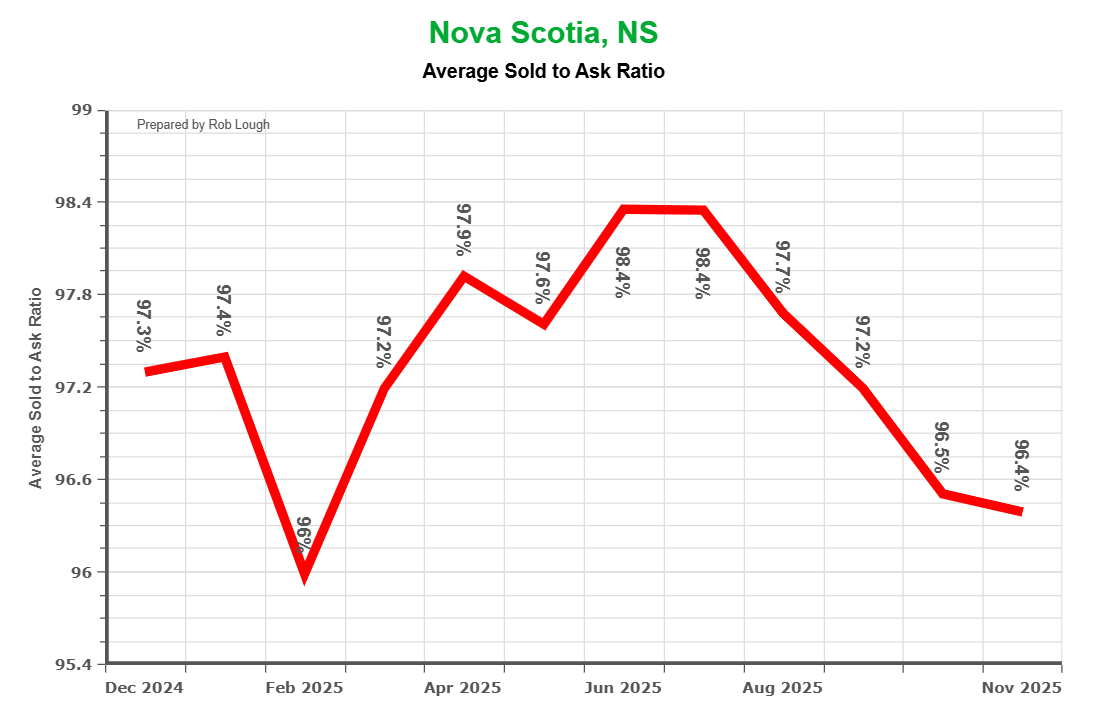
Nova Scotia Real Estate Stats for November 2025 Average Sold to Ask Ratio
The sold-to-ask ratio remained impressively consistent throughout the year, fluctuating only between 96% and just under 99% of listing prices. This tight range demonstrates market health, realistic pricing strategies, and strong underlying demand.
Even during the winter slowdown, sellers averaged better than 96% of asking prices. February’s 96% represented the year’s low point but still indicated limited buyer leverage. Spring and summer brought peak seller power, with April through July consistently achieving 97.5% to 98.4% of asking prices, suggesting multiple-offer situations became common during peak season.
Fall saw modest easing to the 96.5% range by November, giving buyers slightly more negotiating room as competition decreased. However, the fact that sellers still achieved better than 96% of asking prices year-round demonstrates the continued strength and balance in Nova Scotia’s housing market.
Market Context and Long-Term Trends
The 2024 to 2025 data reveals a market that has found its sustainable rhythm after years of pandemic-driven volatility. The clear seasonal patterns, winter slowdown, spring surge, summer peak, and fall moderation, represent a return to historical norms that benefit market stability. As highlighted in our analysis of why Nova Scotia’s housing market outshines major Canadian cities, the province continues benefiting from strong interprovincial migration while offering better value than markets like Toronto or Vancouver.
Nova Scotia continues benefiting from strong interprovincial migration, expanding job opportunities in technology and healthcare, and relative affordability compared to larger Canadian markets. These fundamentals support ongoing demand even as the market transitions from the frenzy of recent years to more measured growth.
Takeaway for Buyers and Sellers
For Buyers: Winter and early spring offer the best negotiating conditions, with fewer competing buyers and more time for due diligence. However, inventory selection is limited. Summer provides maximum choice but intense competition. Fall represents the sweet spot, decent inventory without summer’s frenzy, making it ideal for buyers who can move quickly when they find the right property. Getting mortgage pre-approved before shopping is essential in any season to strengthen your negotiating position.
For Sellers: The data strongly supports late spring and summer listing strategies when possible. Properties listed from May through August benefit from maximum buyer activity, fastest sale times, and strongest pricing power. Those who must sell during off-peak periods should price competitively and expect longer marketing times, though the consistently high sold-to-ask ratios suggest properly priced homes sell well year-round. Learn more in our seller’s guide.
Note for investors: If you’re considering investment properties, be aware of the significant OSFI mortgage rule changes coming in January 2026, which will fundamentally alter qualification requirements for investment property mortgages.
The Nova Scotia real estate market has demonstrated remarkable resilience and growth over the past year. With 6.9% price appreciation, healthy transaction volumes, and clear seasonal patterns, the market is positioned well heading into 2026. Whether you’re buying your first home, upgrading for a growing family, or preparing to downsize, understanding these trends helps you make informed decisions in Atlantic Canada’s dynamic housing market.