Facebook
 X
X
 Pinterest
 Copy Link
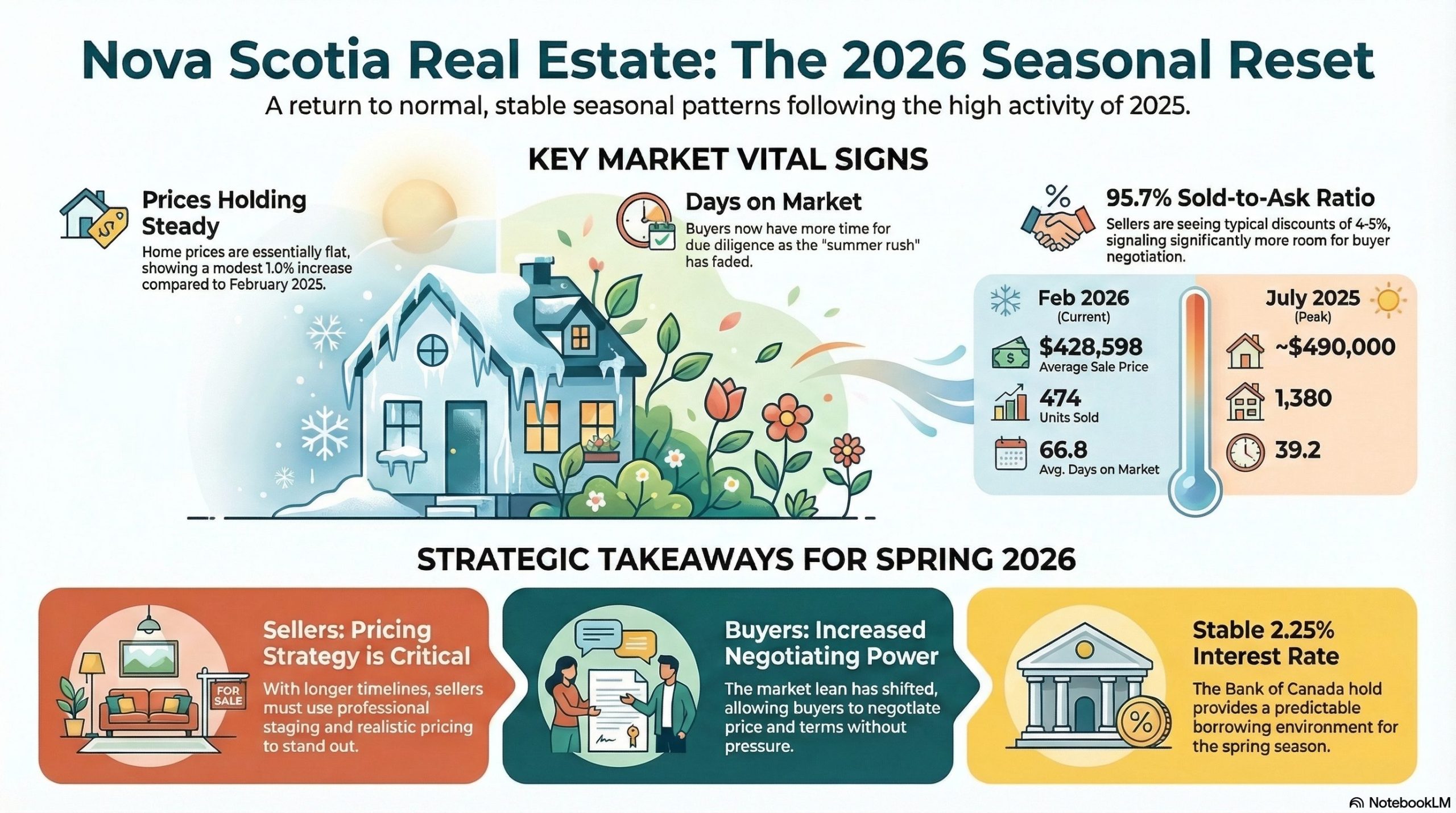
Nova Scotia Real Estate Market Stats for February 2026
By Rob Lough, Broker/Owner | Century 21 Optimum Realty Published: March 2026
February’s numbers are in, and they paint a clear picture of where Nova Scotia’s real estate market stands heading into spring 2026. The frenzy of mid-2025 has given way to a more measured pace, with longer days on market, softer sold-to-ask ratios, and fewer transactions. But before anyone hits the panic button, the headline worth remembering is this: prices are essentially flat year over year, and the seasonal patterns we’re seeing are entirely normal for our province.
If you missed the year-end wrap-up, our Nova Scotia Real Estate Market Statistics 2025 article provides the full context for how we got here. And for a longer-range view of where this market has been, our Five Years of Nova Scotia Real Estate Market Analysis (2021-2025) breaks down the full transformation.
Let’s dig into the February 2026 data.
Average Home Prices: Flat Year Over Year
The average sale price for Nova Scotia homes in February 2026 came in at $428,598, down from a January 2026 spike to $491,129 but sitting just about 1% above where we were in February 2025 ($424,504). That +1.0% year-over-year return on investment tells an important story: this is not a market in freefall.
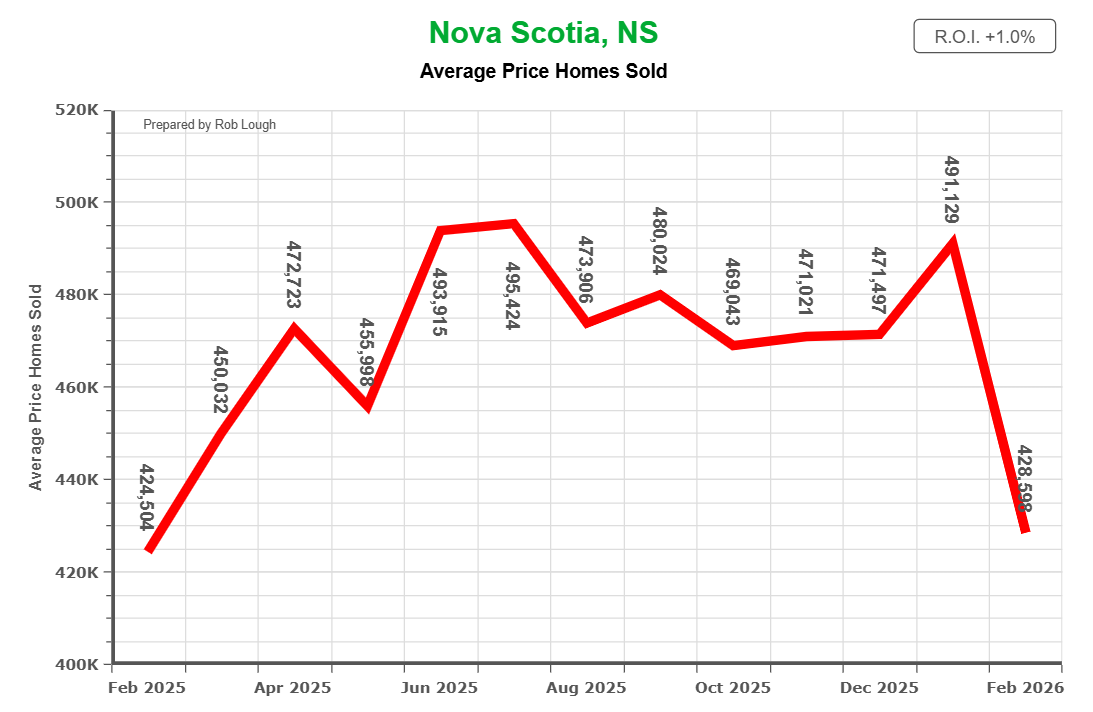
Average Price home sold Nova Scotia Real Estate Market Stats for February 2026
Prices climbed steadily through the spring and summer of 2025, peaking in the high $490s in June and July before oscillating in the $469,000 to $491,000 range through the fall and early winter. The February dip reflects the seasonal compression we see every year when buyer activity drops and the mix of properties closing shifts toward lower price points.
For sellers, your property’s value hasn’t evaporated. The market has simply reset to its normal seasonal rhythm after an unusually active 2025. Pricing strategy matters more than ever right now, and if you’re thinking about listing this spring, our sellers guide is worth a look.
For buyers, the flattening of prices means you’re not chasing a runaway market. There is breathing room to make smart, informed decisions without feeling like every week of hesitation costs you thousands.
Units Sold: Winter Slowdown Is Textbook
Nova Scotia recorded 474 home sales in February 2026, down from 543 in January and a significant step back from the summer 2025 peak of 1,380 units in July. For context, February 2025 saw 517 sales, so we’re looking at a modest year-over-year decline of about 8%.
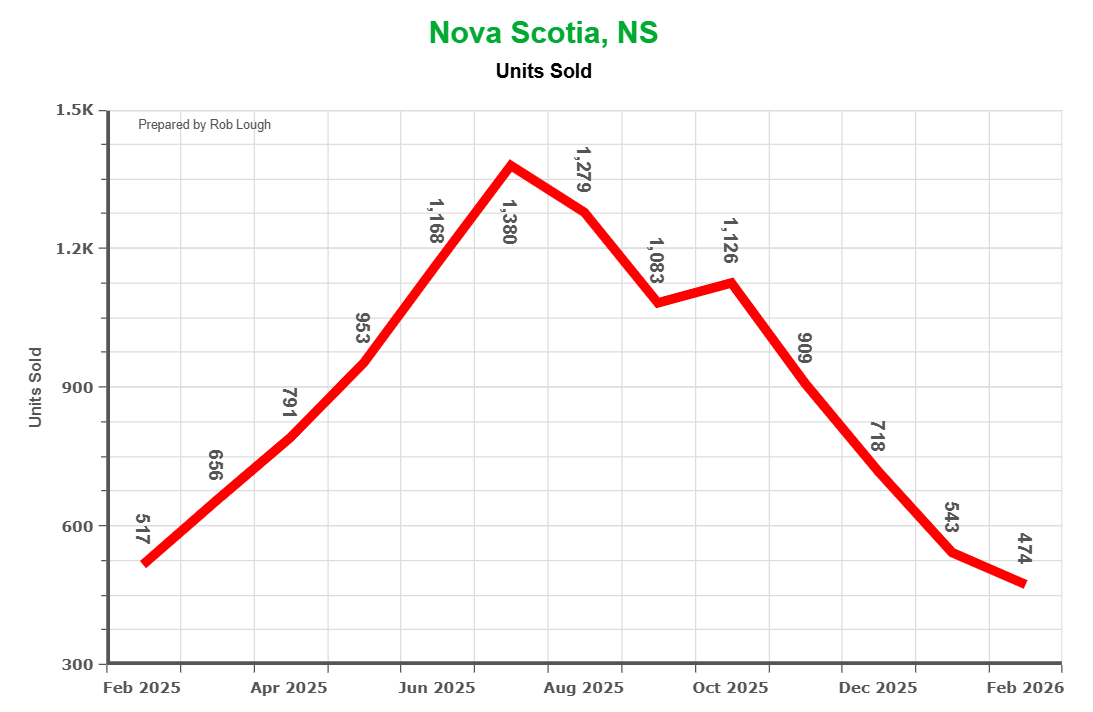
Number of Units Sold Nova Scotia Real Estate Market Stats for February 2026
The seasonal arc here is textbook for our province. Sales ramp from roughly 500 in the late winter months through the spring, peak in the 1,100 to 1,400 range during summer, and then bleed off steadily through fall and winter. Nothing in this data suggests anything other than normal cyclical behaviour.
Total Dollar Volume: Following the Seasonal Script
The total value of homes sold in February 2026 was $203,155,314, representing the lowest point in the trailing 12-month period. At the summer peak in July 2025, that figure was $683,684,879, more than triple February’s total.
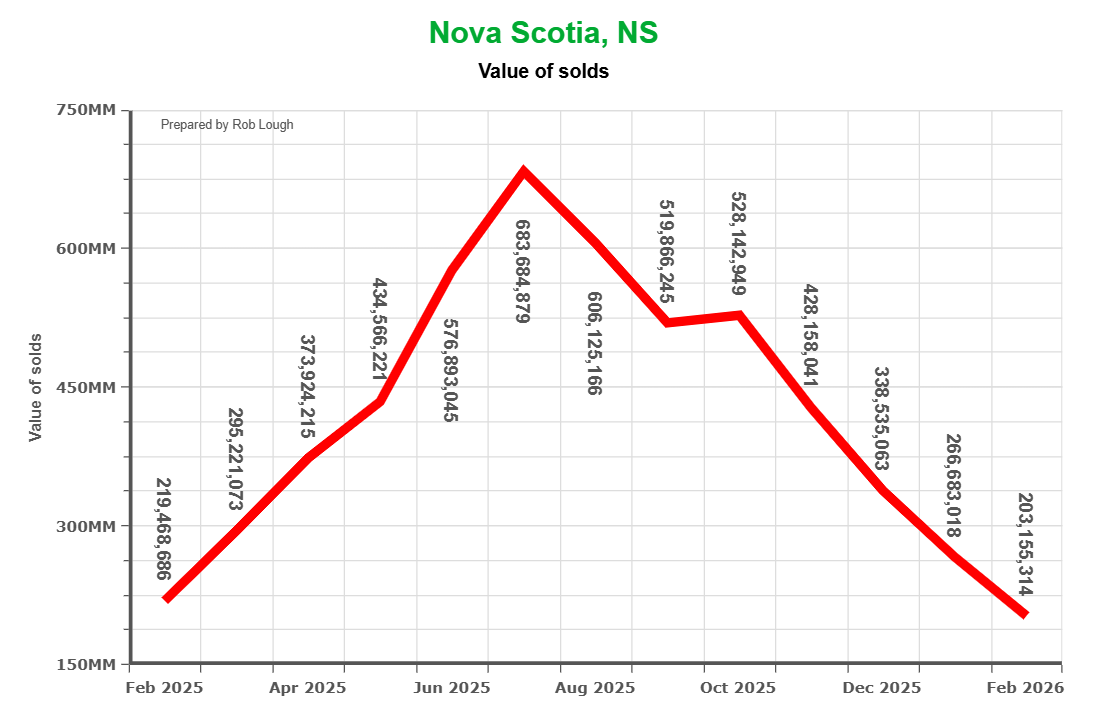
Value of sold properties Nova Scotia Real Estate Market Stats for February 2026
This drop reflects both fewer transactions and the seasonal pricing dip working together. It does not indicate a structural shift in market fundamentals. As listing activity picks up through March and April, expect this number to climb in step with the spring buying season.
Days on Market: Buyers Have Time to Think
Average days on market in February 2026 reached 66.8 days, nearly back to February 2025’s reading of 69.6 days. This represents a dramatic shift from the summer trough of just 39.2 days in July 2025, when well-priced homes were moving in under six weeks.
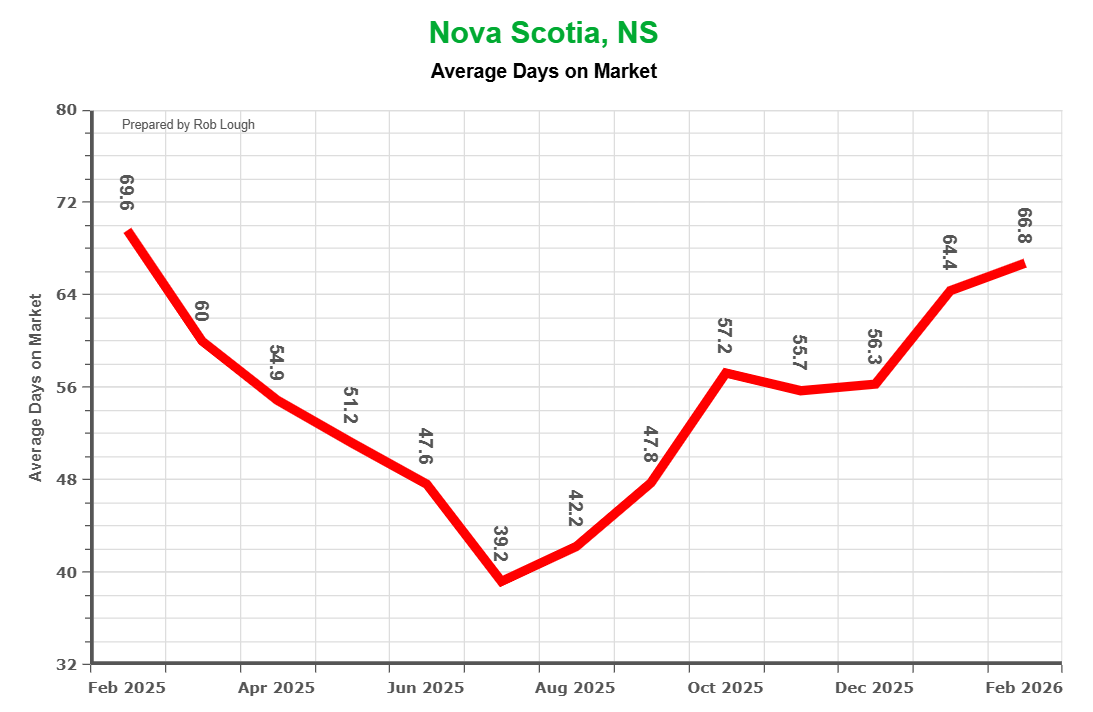
Average Days on Market Nova Scotia Real Estate Market Stats for February 2026
The DOM trend has traced a clear U-shape over the past year: falling from the low 70s in winter 2025 through to the high 30s at the summer peak, then climbing steadily back to current winter levels. This pattern reflects strong spring and summer absorption followed by the predictable seasonal slowdown.
For sellers, plan for 60 to 70 days on market rather than assuming a two-week sale. Staging, professional photography, and strategic pricing are your best tools for standing out when buyers have more options and more time to shop. Our buying and selling tips page has practical guidance for positioning your property.
For buyers, the current DOM environment works in your favour. You have time to do your due diligence, schedule inspections without pressure, and negotiate without feeling rushed. If you haven’t started the mortgage process yet, getting pre-approved should be your first step.
Sold-to-Ask Ratio: Room to Negotiate
The average sold-to-ask ratio for February 2026 was 95.7%, a slight uptick from January’s 95.3% but well below the summer 2025 highs of 98.4% in June and July.
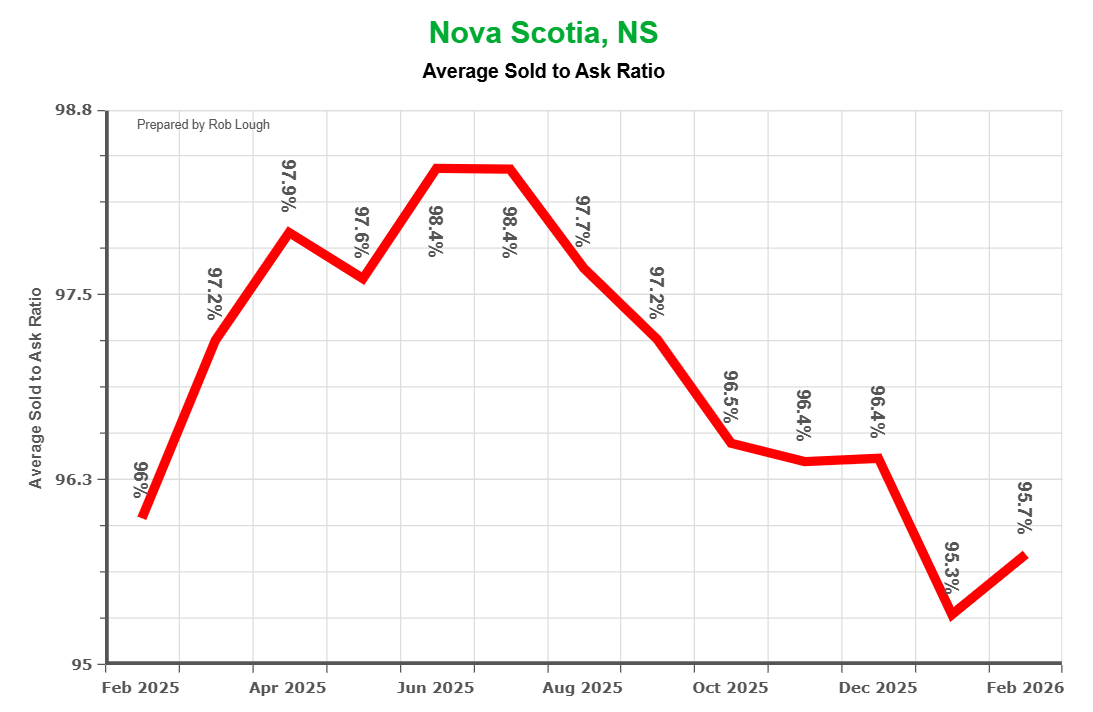
Sold to ask Ratio Nova Scotia Real Estate Market Stats for February 2026
This is a meaningful shift from where we were six months ago. During the competitive summer months, homes were selling at near-full asking price and sometimes over ask. Today, typical discounts are running in the 4% to 5% range, indicating less competitive bidding and significantly more room for negotiation.
Ratios rose from about 96% in February 2025 to just under 99% by late spring, then steadily trended downward through the fall and into 2026. That trajectory tells us the urgency that defined last year’s peak season has faded, and the balance of power has shifted modestly toward buyers.
Interest Rates and the Broader Picture
The Bank of Canada held its overnight rate at 2.25% at its January 28 announcement, with the next decision date set for March 18, 2026. Most analysts expect rates to hold steady through the spring, providing a predictable borrowing environment for both buyers and sellers.
With prime rate sitting around 4.45%, variable rate mortgage holders are in a stable position, and fixed rate offerings remain competitive. If you’re considering a purchase, our mortgage calculator can help you run the numbers for your situation.
For first-time buyers, it’s also worth knowing about Nova Scotia’s 2% Down Payment Program, which can significantly reduce the upfront cash required to enter the market. We’ve also covered how first-time buyers in Canada face a tougher climb than past generations and what strategies are working right now.
What This Means for You
If you’re selling: Pricing sharply matters again. The days of listing high and letting the market come to you are behind us for now. Expect more conditional offers, longer timelines, and buyers who are doing their homework. Differentiation is key because buyers have options. Invest in staging, quality photography, and a realistic pricing strategy informed by current comparables, not summer 2025 comps. If you want to understand what your home is worth in today’s conditions, our free home valuation tool is a good starting point.
If you’re buying: This is a more balanced to mildly buyer-leaning environment than anything we’ve seen since 2021. You can negotiate on price and terms, look at listings that have been sitting for a while, and take the time to find the right property rather than scrambling to compete. Don’t let early spring optimism push you into a decision without solid comparable sales data backing it up. Our buyers guide walks through the process step by step.
If you’re investing: Flat year-over-year prices, softening ratios, and rising days on market point to a potential entry window where cash flow and yield matter more than quick appreciation. Underwriting should assume modest or zero short-term price growth and focus on rent fundamentals. Keep in mind that investment property mortgage rules changed in January 2026, so factor those new qualification requirements into your planning.
Looking Ahead to Spring 2026
If you’ve been watching from the sidelines, our recent Spring 2026 in Halifax article outlines exactly what to expect and how to prepare. The spring market typically brings a surge in both listings and buyer activity, and this year should be no exception.
Nova Scotia’s population growth continues to support housing demand, even as the pace has moderated from pandemic-era highs. Combined with stable interest rates and a construction sector that’s been ramping up new starts, the outlook for 2026 is one of measured activity and incremental price stability rather than dramatic swings in either direction. New province-wide NSAR research backs this up, 77% of Nova Scotians say housing in their area is unaffordable, with aspiring owners the most concerned of any group surveyed.
Whether you’re buying, selling, or investing in Nova Scotia real estate, the most successful transactions start with a plan, not a reaction. If you’d like to talk strategy for the spring market, don’t hesitate to reach out.
Related Resources
- Nova Scotia Real Estate Market Statistics 2025
- Five Years of Nova Scotia Real Estate Market Analysis (2021-2025)
- Nova Scotia Real Estate Stats for November 2025
- Halifax-Dartmouth Real Estate Market Stats January 2026
- Truro-Bible Hill Real Estate Market Stats January 2026
- Bank of Canada Holds Overnight Rate at 2.25%
- Nova Scotia’s 2% Down Payment Program
- Spring 2026 in Halifax: Your Complete Guide
- Get Pre-Approved for a Mortgage
- What’s My Home Worth?